by Council Staff | May 21, 2026 | Add Council Logo, Council News, John Goncalves, Justin Roias, Mary Kay Harris, Press Release, Rachel Miller, Sue AnderBois
The ordinance strengthening PERA requires one more vote to become law
Providence, RI – Tonight, councilors voted for the first time to strengthen civilian oversight of the Providence Police Department (PPD) by expanding the Providence External Review Authority’s (PERA’s) oversight powers. Currently, PERA relies heavily on PPD for access to information, which limits its ability to operate independently.
Sponsors of the bill say that the proposed amendments would give PERA the tools, access, and authority to conduct real, independent oversight with direct access to internal police systems and records, the ability to audit Internal Affairs investigations, and the creation of an Early Warning System to flag officers who may need counseling or retraining. These reforms would give Providence residents a clearer path to review from outside the police department, strengthening accountability and increasing public safety.
“For years, PERA has been tasked with investigating police misconduct without the tools, access, and authority to do that work independently,” said Council President Rachel Miller. “Today’s vote is a major step toward real civilian oversight—giving PERA meaningful access to the systems and information it needs to conduct independent investigations and strengthen public trust. This legislation builds on decades of organization by community members who have demanded a system of accountability that does not depend on the institution it is meant to oversee. Real public safety means safe neighborhoods, yes—but it also means confidence that when harm occurs, there is a path to justice.”
Additionally, councilors finalized passage of the $3 million Green Revolving Fund and $5.45 million Community Development Block Grant (CDBG) budget, significant investments in the overall health and well-being of Providence residents and the city itself.
CDBG funds reach every corner of the city. Distributed as grants to the city’s community centers and public service organizations, utilized for neighborhood park and facility improvements, and invested in homelessness prevention and affordable housing projects, CDBG funding decisions reflect the needs of the city as well as ward priorities.
“This has been the most efficient and collaborative URRP process of my term,” said Councilwoman Mary Kay Harris (Ward 11), who serves as chair of the Committee on Urban Redevelopment, Renewal, & Planning (URRP). “I’m so proud of how many programs and projects we have been able to meaningfully support in this new funding cycle.”
Some important allocations of funding to highlight include:
- $20,000 for the Mathewson Street United Methodist Church’s food services program.
- $40,000 for the Rhode Island Hispanic Chamber (which recently celebrated its tenth anniversary!) of Commerce for economic development support.
- $657,360 housing grant for Amos House to rehabilitate homes at 428, 430, and 434 Pine Street.
- An additional $70,000 for Amos House’s A Hand Up program, which offers work opportunities to more than 500 people who are actively participating in, and at risk for, panhandling.
- $85,000 for the Woonasquatucket River Watershed Council’s “Merino Park and Greenway Accessibility Project.”
- An additional $75,000 in Ward 6 and Ward 7 neighborhood investment funding to support Merino Park pedestrian access improvements.
Mayor Brett Smiley and the City Council will issue a more detailed joint press release on CDBG projects and the benefits of the ordinance.
While the CDBG budget focuses on building healthy and well-supported communities, the Green Revolving Fund looks to the emissions footprint of city buildings. The GRF will serve as a much-needed mechanism for the city to reach its goal for municipal buildings to be carbon neutral by 2040. Projects will include such improvements and upgrades as installation of heating, ventilation, and air conditioning systems; installation of solar panels and other renewable energy systems; and weatherization and other updates to tighten building envelopes. The savings from the reduction in energy costs, alongside incentives and rebates, will be reinvested into the Fund.
“The work that we are doing to decarbonize, to invest in energy efficiency, it is working, not just to help the environment, but to save our residents and our taxpayers real money,” said Green Revolving Fund sponsor Councilor Sue AnderBois (Ward 3) during the May 7th city council meeting. “Providence [is] leading the way and showing that we’re seeing savings. And even if the federal and state governments try to disinvest in this, we’re going to use our savings to create our own incentives to keep going.”
“If decarbonization doesn’t move you, then let cost savings move you,” added Councilor Justin Roias (Ward 4).
Councilman John Goncalves (Ward 1) introduced an ordinance that would prohibit rent increases above 10% during states of emergency, and for 30 days afterward, declared by the President or Governor and the Mayor. The ordinance would create a 3-1-1 complaint category for tenants to report rent increases of 15% or more and require housing inspections when tenants report rent increases of 25% or more, with credible supporting documentation. The ordinance was referred to the Special Committee on Health, Opportunity, Prosperity, and Education for further review.
Just in time for summer, councilors completed first passage of the updated entertainment ordinance. The updated ordinance creates the definition of expanded incidental entertainment, clarifies what qualifies as entertainment under this new definition, changes licensing requirements, and sets clearer hours for general indoor and outdoor music, while reinforcing noise regulations in consideration of nearby residents. According to sponsors, the updated ordinance is necessary to support and create consistency for the local artists and venues that make Providence the Creative Capital.
The next regular City Council meeting will convene on June 4, 2026.
by Council Staff | Apr 10, 2026 | Add Council Logo, Council News, John Goncalves, Press Release
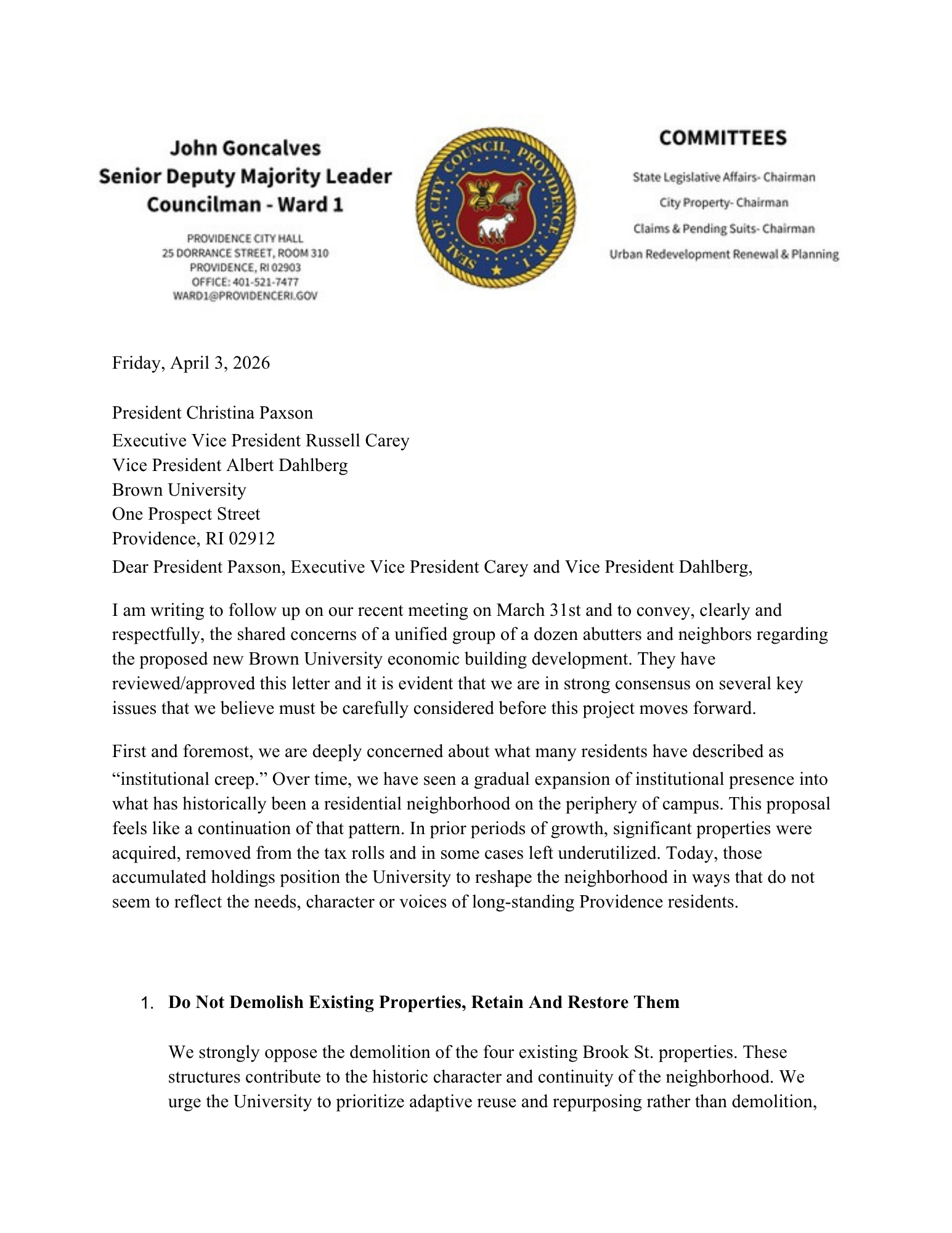
Providence, RI – Brown University may soon be advancing plans for a new economics building on Brook Street, between Benevolent and Charlesfield Street. Today, I’m joining neighbors next to the proposed site in raising serious concerns about the future of this historic residential area.
We have seen this pattern before. When the Brook Street dorms were built, many of us worried about the precedent it would set. Today, those concerns are becoming reality, with continued expansion into our residential neighborhoods, often referred to as institutional creep.
At the heart of this issue are four existing homes that Brown is proposing to demolish to make way for this new economics building that, given its scale and massing, will inevitably overwhelm the surrounding homes and fundamentally alter the character of the neighborhood. These homes are part of the fabric and history of the neighborhood. Once they are gone, they are gone for good. We are asking Brown to pursue restoration and adaptive reuse instead of demolition.
This is also about being a good neighbor. If Brown truly loves Providence, it should respect the character, scale and voices of the community that surrounds it.
We remain committed to a constructive dialogue but we are clear in our position: these homes should not be demolished.
John Goncalves
Councilman, Ward 1
Providence City Council

by Council Staff | Mar 19, 2026 | Add Council Logo, Council News, Housing, John Goncalves, Press Release, Rachel Miller, Shelley Peterson
Providence, RI – Tonight, Providence City Council held a full meeting in the Council Chamber on the third floor of City Hall, where councilors presented several ordinances and resolutions on the topic of housing.
Councilman John Goncalves (Ward 1) introduced a Rent Housing Subsidy Ordinance, which would establish the Rental and Essential Needs Transition, or RENT Fund, and provide up to $3,000 in emergency one-time financial assistance to households at imminent risk of housing loss, shut-off of utilities, or insurance coverage loss. As written, the $800,000 in rental assistance funds would help up to 300 Providence households. This measure was announced earlier this week at a press conference with Mayor Brett Smiley and members of the City Council.
“Families can scrimp and save, plan and budget, but unexpected emergencies happen,” said Councilman Goncalves. “We created the RENT Fund because evictions ruin people’s lives. This fund will provide short-term relief to help struggling tenants through those moments of crisis so they can stay in their homes and communities.”
Like last year’s rental algorithm price-setting ban and the current proposed rent stabilization ordinance, the creation of an emergency eviction prevention fund is a recommendation from the 2025 Housing Crisis Task Force Report. According to the report, “[e]ven modest, one-time rental assistance payments have been shown to prevent displacement, stabilize families, and reduce the need for costly emergency shelter and rehousing services.”
The ordinance, which is sponsored by all 15 councilors, was referred to the Committee on Finance.
Councilors passed a resolution on the floor in opposition to H-8006, a Rhode Island State bill that would expand “8-Law,” which was originally designed to ensure fair and consistent taxation for low-income housing, to allow commercial-to-residential projects to qualify for a tax break if just 10% of the units in it are affordable to households making up to 120% of the area median income. The resolution raises concerns that the proposal undermines municipal taxing authority and shifts the burden onto local taxpayers.
“Workforce housing, while critically important, is not low-income housing, and municipalities cannot afford to tax it as if it were,” said Council President Rachel Miller (Ward 13). “Conversions are highly expensive, and the City Council is a willing partner in providing appropriate subsidies to enable them, provided that the granting authority rests with municipalities. As written, this bill would subsidize the wealthiest developers in the state while shifting the burden onto homeowners and other property owners.”
Earlier this month, Council President Miller sent a letter of opposition to the Committee on Municipal Government and Housing. The full letter is available upon request.
Councilors heard another ordinance in line with recommendations from the Housing Crisis Task Force Report. Councilwoman Shelley Peterson (Ward 14), who led the Student Housing Task Force for about two years, introduced an amendment to the zoning ordinance establishing Student Housing Overlay Districts. The ordinance would create overlay districts to allow for higher-density off-campus student housing in designated areas surrounding colleges, while establishing a clear review process and standards to protect surrounding neighborhoods from overconcentration and gentrification. It is designed to ensure community voices are heard and considered in the development process, and to better plan, manage, and align student housing growth with the needs of the broader neighborhood beyond the immediate surrounding streets.
“Providence is very much a college town, so we need to protect our neighborhoods while accommodating student housing needs,” said Councilwoman Peterson. “This overlay district will help the city manage student housing density in a way that works for long-term Providence residents as well.”
The proposed ordinance was referred to the Special Committee on Health, Opportunity, Prosperity, and Education (HOPE Committee).
Councilors also heard a resolution in support of deed fraud protection bills at the General Assembly. President Pro Tempore Juan M. Pichardo (Ward 9) worked on related legislation during his tenure as a Rhode Island State Senator. The resolution was referred to the HOPE Committee.
Several additional resolutions supporting state legislation, including many that focused on childcare, were referred to the Special Committee on State Legislative Affairs.
The next regular City Council meeting will convene on April 2, 2026.
by Council Staff | Mar 5, 2026 | Add Council Logo, Council News, Jo-Ann Ryan, John Goncalves, Miguel Sanchez, Press Release, Sue AnderBois
Tonight, Providence City Council held a full meeting in the Council Chamber on the third floor of City Hall.
At the meeting, councilors unanimously finalized passage of an ordinance amendment regulating building design standards and updates to the utility permits ordinance.
In 2024, then-Councilwoman Helen Anthony (Ward 2) introduced an amendment to the Comprehensive Plan encouraging new housing to reflect the character and aesthetic of Providence’s neighborhoods. The ordinance passed tonight, introduced by Councilwoman Jo-Ann Ryan (Ward 5), codifies that vision into law by establishing design standards for new residential construction.
The new exterior standards include requirements for primary entrances that are visible from the public right-of-way, limits on the elevation of front entrances, pressure-treated wood to be finished rather than left exposed, screening beneath porches, stairs, and landings, and architectural features such as windows, porches, and entrances to prevent blank building facades. These provisions are intended to ensure new development enhances—rather than disrupts—the communities it joins, without increasing construction costs or delaying project timelines. Through these standards, the Council intends for new housing developments to help positively shape the landscape of Providence’s neighborhoods for years to come.
“I am pleased to have sponsored this important legislation that establishes practical and predictable development rules. Providence wants and needs new development, especially new housing, to meet the needs of current and future residents. It is essential, reasonable, and responsible to ensure that new development fits within our existing neighborhoods and complements the built environment that residents care deeply about. Scale, massing, and architectural details matter—they shape how buildings relate to the street, to nearby homes and businesses, and the overall character of our neighborhood,” said Councilwoman Ryan. “These new design standards will improve design quality without increasing construction costs or extending review timelines while supporting housing production that maintains the character of our neighborhoods.”
The updates to the utility permits ordinance address common complaints from residents about the serious obstacles presented by unexpected utility work in their neighborhoods. The ordinance now requires that any utility company receiving a permit to alter, install, or upgrade equipment on public or private property notify nearby property owners with a detailed schedule of when the work will be happening, a plan for how the utility company will coordinate to avoid unnecessary disturbances to Providence residences, and plans for daily clean-up, equipment storage, and full restoration of sidewalks and streets. In order to ensure compliance with the ordinance, failure to submit plans before non-emergency work starts—or deviation from the plans—may result in fines of up to $500 per day.
“Too often, neighbors report no notice before their streets are opened – blocking them in their driveways making them late for work, leaving tools on their yards, leaving the roads in disrepair for sometimes months at a time,” said Councilor Sue AnderBois (Ward 3), who introduced the ordinance. “Taxpayers of the city own these streets. And while utilities provide services, many are large, out-of-state corporations that make big profits off of expanding their infrastructure. Our neighbors and their property deserve respect.”
In light of the historic snowfall in recent weeks, councilors took multiple actions to support the Providence community.
Councilman John Goncalves (Ward 1) introduced a resolution requesting the mayor research the use of a publicly accessible tracking system for snow removal vehicles. This measure aims to increase the transparency of clean-up operations during and after snowfall. Councilors referred the resolution to the Committee on Public Works.
Councilor Miguel Sanchez (Ward 6) introduced a resolution in support of Rhode Island Senate Bill 2264, which would fund and equip warming and cooling centers during extreme heat and cold spells, along with an accompanying ordinance that matches the state bill at the city level. Both the resolution and the ordinance were referred to the Special Committee on Health, Opportunity, Prosperity, and Education.
Through an invocation and a resolution, councilors honored the lives of Irina Kozav, Stanislaw Kozav, and Ryan Boisvert, whose deaths were all attributed to the freezing cold temperatures that hit the city in late January.
Scientists agree that extreme weather like Rhode Island has seen this winter is a hallmark of climate change, which poses an ongoing and serious threat to human health and the environment. In response, Rhode Island legislators have introduced House Bill 7183 and Senate Bill 2260 to establish a statewide energy efficiency benchmarking program. Councilor AnderBois introduced a resolution in support of the bills, which was referred to the Special Committee on Environment and Resiliency.
The next regular city council meeting will take place on March 19, 2026.
by Council Staff | Feb 5, 2026 | Add Council Logo, Council News, Jill Davidson, John Goncalves, Oscar Vargas, Press Release, Rachel Miller, Shelley Peterson, Sue AnderBois
Providence, RI – Tonight, the Providence City Council held a full meeting in the Council Chamber on the third floor of City Hall.
Councilors unanimously approved a resolution denouncing Immigration and Customs Enforcement’s campaign of aggression around the country, and specifically the unjust killings of Alex Pretti and Renee Good, who were tragically killed by immigration enforcement agents in Minneapolis. As communities organize to support and protect each other from these violent, reckless attacks, Providence councilors extend solidarity and support to the people of Minneapolis.
“Federal officers are leading a campaign of terror in Providence and around the country, violating the constitutional rights of residents en masse,” said Council President Rachel Miller (Ward 13). “Today we stand with Minneapolis, and we rise together to defend democracy here and everywhere by calling on our Congressional delegation to abolish an agency that is perverting the principles of justice and fair treatment under the law.”
As Providence residents continue to report difficulty navigating snow and ice on the city’s streets, several councilors introduced a resolution seeking information, reflection, and accountability on the City’s storm preparation and management. The City Council’s Committee on Public Works held a public meeting with DPW leadership to discuss the handling of the storm on Tuesday, February 3. The resolution, which requests a formal report from the Department of Public Works, was referred to the Committee on Public Works.
“Obviously, a combination of intense snow accumulation, extreme cold, and insufficient resources led to a less-than-stellar response by DPW,” said Councilwoman Shelley Peterson (Ward 14). “I look forward to reading DPW’s report so we can join the Administration in finding ways to improve our storm planning and management in the future.”
In response to reports that many stores in the greater Providence area have sold out of road salt, Councilman Oscar Vargas (Ward 15), who chairs the Committee on Public Works, presented a resolution requesting DPW distribute at least one ton of the city’s salt supply to residents to help clear sidewalks and driveways. The resolution was passed on the floor.
“Unfortunately, over the last week DPW’s plows have pushed snow into constituents’ sidewalks and driveways, causing accessibility issues,” said Councilman Vargas. “We’ve been experiencing extreme cold temperatures, and not all of the snow and ice has melted. With the lack of road salt available for purchase, we’re proposing that DPW provide some of their salt to Providence residents to melt the ice so pedestrians, strollers, and wheelchairs can once again get around safely.”
Councilors also introduced a resolution promoting sustainable and equitable funding for stormwater and sewer management. Providence has experienced 13 significant flooding events in the past three years that have endangered residents and damaged homes and businesses. In response, a Sustainable Stormwater and Sewer Assessment Study Task Force recommended establishing dedicated user fees for stormwater and sewer management. The resolution, which was introduced by Councilor Jill S. Davidson (Ward 2) and Task Force member Councilor Sue AnderBois (Ward 3), supports working in collaboration with the Administration to advance the task force’s recommendations, engage community members, and develop an implementation framework. It was referred to the Special Committee on Environment and Resiliency.
In a continued effort to advocate for safe, affordable housing, councilors heard two resolutions supporting state legislation that addresses housing issues. Councilors unanimously passed a resolution, introduced by Council President Miller, which supports $25 million general obligation housing bonds in the General Assembly. A second resolution introduced by Councilwoman Peterson supports H-7199 and S-2291, which amend the Residential Landlord and Tenant Act to allow victims of domestic violence and sexual abuse to terminate a lease early without penalty or liability. This resolution was referred to the Special Committee on State Legislative Affairs.
Councilors also unanimously approved a resolution introduced by Councilman John Goncalves (Ward 1) recognizing International Holocaust Remembrance Day, which took place on January 27, 2026. January 27th is the anniversary of the day the Red Army liberated the Auschwitz-Birkenau Nazi concentration and extermination camp.
Councilors approved Mayor Brett Smiley’s appointment of Andrew Bramson, President and CEO of Onward We Learn, to the Providence School Board for Region 1. Bramson is currently serving as the Board Chair of the Central Falls School District.
The next city council meeting will take place on February 19th, 2026.
by Council Staff | Jan 22, 2026 | Add Council Logo, Council News, Jo-Ann Ryan, John Goncalves, Juan M. Pichardo, Press Release, Rachel Miller
Providence, RI — Tonight, a majority of the City Council formally introduced the highly anticipated rent stabilization ordinance. This proposal was announced at an event on Tuesday, January 20th, with Council President Rachel Miller (Ward 13) and President Pro Tempore Juan M. Pichardo (Ward 9), other sponsoring councilors, landlords, renters, and housing advocates. Together, they emphasized the urgent need for this policy proposal. The ordinance was referred to the Special Committee on Health, Opportunity, Prosperity, and Education (HOPE), where there will be a robust public process including considerable opportunity for public input.
Just days after Brown University students returned to campus for the first time since December’s tragic shooting, councilors unanimously approved a resolution recognizing the countless first responders and community members who supported distressed students and neighbors during and after the attack. The heroic, generous efforts of the Providence Police Department, Brown University Department of Public Safety, RIPTA bus drivers, Brown staff, mutual aid networks, and others helped our community navigate this unprecedented tragedy with care and grace.
In addition, councilors unanimously approved a resolution supporting General Assembly legislation to raise the maximum reimbursement from PILOT aid from 27% to 30%, bringing much-needed revenue to the City following last year’s court settlement on school funding. The resolution was introduced by Councilman John Goncalves (Ward 1).
Councilman Goncalves also introduced a resolution urging passage of the 2026 Save RIPTA Legislative package in response to a $10 million budget deficit that affected 45 of the system’s 63 routes and reduced overall service by 15%. If enacted, the package would support the long-term health of the bus system and those who depend on it by providing reliable funding avenues and addressing capital improvement issues. The resolution was referred to the Committee on State Legislative Affairs.
The Council approved a resolution from Councilwoman Jo-Ann Ryan (Ward 5) establishing the Special Commission on the History of the Providence City Council. The commission will be tasked with the preservation of the Council’s institutional, legislative, and structural history, and with assembling and organizing records of the Council’s past actions, development, operation and governance practices to ensure their accessibility to the public and to current and future City leaders.
Rent Stabilization
Providence has the fastest rent growth in the country, even while the national median rent decreased. The median rent in Providence is 40% higher today than it was in 2020. Rising costs have forced working families out of the city and have directly contributed to rising rates of homelessness. Since March 2020, Providence has experienced more than 24,000 evictions. Between 2023 and 2024, Rhode Island experienced a 35% rise in homelessness, the second-highest increase in the country.
Sponsoring councilors developed the ordinance in order to create stability and predictability for Providence renters while supporting a healthy housing market. It allows owners of covered properties to raise rents up to 4% annually, includes exceptions for major tax increases and substantial capital improvements, provides for exemptions for a variety of properties including new construction and small owner-occupied buildings, and establishes a Rent Board to enforce tenant protections, grant exemptions to property owners, and resolve disputes. The ordinance is a balanced, Providence-specific approach—one that stabilizes housing for Providence families while ensuring property owners achieve a fair rate of return.
“Providence renters are cost-burdened—we are the least affordable city for renters in the country. We have to act now to create some stability for Providence families,” said Council President Miller. “This ordinance takes immediate action to give residents the breathing room they need. It stabilizes costs, slows a runaway rent pricing problem that will not regulate itself, and prevents our residents from being forced out of our city, all without slowing growth.”
Notable features of the Providence Rent Stabilization Ordinance include:
- Caps annual rent increases at 4%. A landlord cannot raise the rent by more than 4%, absent a special circumstance, in any 12-month period.
- Sets base rent as the rent charged 180 days before the ordinance takes effect, preventing last-minute price spikes before the law goes into force.
- Establishes a Rent Board to administer and enforce the rules. This five-member board and their staff will review landlord petitions for larger increases, hear tenant complaints, and ensure the ordinance is followed fairly.
- Tenants can report suspected violations and are protected from any landlord retaliation for exercising their rights. The Rent Board can roll back unlawful rent hikes, order landlords to refund overcharged rent, and the City can levy fines for serious violations.
- Exemptions for small, owner-occupied buildings with one to three units, such as duplexes and triple-deckers where the owner lives on-site. A narrow exemption for one additional small property owned by the same individual (not a corporation).
- A 15-year exemption for new construction, including currently existing buildings, to ensure that rent stabilization does not interfere with housing production or financing.
- Built-in flexibility for landlords to address major expenses. Owners can seek approval for a higher rent increase if they make significant capital improvements or have other special circumstances where a larger increase is necessary to ensure they can earn a fair return.
- Automatic flexibility for large property tax increases, allowing landlords to pass on a fair portion of unusually high tax hikes above a 5% threshold using a clear formula.
- Rent can only be increased one time by 4% when a tenant moves out and a new tenant moves in, maintaining stability through vacancies.
- Complaint-based enforcement, allowing tenants to report violations without creating a large new bureaucracy or annual reporting burden on property owners.
- Utility charges must reflect actual costs, ensuring that landlords may only pass through the real price of utilities and not mark them up.
- Properties must be up to code to qualify for annual rent increases, meaning landlords must maintain safe, habitable buildings in order to apply the standard 4% increase.
Since the start of the term in 2023, the City Council has invested $55 million in the City’s Affordable Housing Trust Fund, overhauled the City’s zoning policy to increase density citywide, and incentivized private development through tax stabilization agreements. These policies have brought hundreds of housing units to the City—in both deeply affordable income restricted developments and market rate new construction. The Council has also increased annual budget allocations to the City’s home repair program that provides forgivable no cost loans to residents to maintain their properties and made a one-time $3 million allocation to the program with American Rescue Plan dollars.
Last year, the Council’s Housing Crisis Task Force concluded a two-year investigation into the issues residents—including those at risk of homelessness—face in finding and keeping stable housing with the release of an extensive report, which included rent stabilization among its recommendations.
For answers to commonly asked questions, the councilors sponsoring the ordinance have put together an FAQ, which will be updated on the City Council’s website at council.providenceri.gov/housinghub/rentstabilizationfaq/. You can also read Council President Miller’s opinion piece in The Boston Globe from January 20th on how rent stabilization could help solve Providence’s housing crisis.