by Council Staff | Jul 16, 2026 | Add Council Logo, Council News, Housing, Jill Davidson, Juan M. Pichardo, Juan Pichardo, Press Release, Rachel Miller
Providence, RI – At tonight’s City Council meeting, councilors passed several major ordinances before recessing for the summer. The next regular City Council meeting will convene on September 17, 2026.
The first ordinance, the Providence 8 Law Qualifications, governs how Providence grants the 8% tax treatment within the city. The 8 Law ordinance will stop the misuse of the low-income tax treatment by wealthy developers who do not substantively build the affordable housing that the state’s 8 Law was meant for. The state’s 8 Law designates the tax treatment for low-income housing, but does not give a definition of low-income, nor specify affordability levels, nor address whether it should be applied to the units themselves or the entirety of the building. This ambiguity creates space for municipalities to administer the program as they deem appropriate and beneficial.
In April 2024, the City Council passed by a 13-2 vote an 8 Law ordinance that would have applied the low-income tax treatment only to the restricted units themselves. The ordinance was then vetoed by Mayor Brett Smiley. Rather than just applying to individual units, the new version passed for the second and final time tonight sets affordability thresholds that work with other low-income housing programs. After taking into consideration feedback from affordable housing developers, the sponsors created an ordinance that will fulfill the intended purpose of the state 8 Law while aligning eligibility with the federal Low-Income Housing Tax Credit and other affordability programs, together ensuring that the tax treatment is only used for properties with meaningful low-income housing.
“After years of work, tonight we put into law that a tax treatment intended for low-income housing must actually be used for low-income housing,” said Council President Rachel Miller (Ward 13). “Wealthy developers have been taking advantage of the City’s most generous tax treatment without providing units affordable to low-income residents. Take 68 Dorrance, for example: a 44-unit market-rate building where only 9 units are income-restricted, and none are restricted for low-income households. Tonight, the Council said clearly: that is not what 8 Law is for. This ordinance protects affordable housing and city revenue by making sure luxury developers pay their fair share.”
Passage of this ordinance is considered to be a major legislative success for the majority of the City Council that has worked on 8 Law reform for the entirety of this term. Besides legislating to end the abuse of the low-income tax treatment, the City Council has pursued a judicial route to properly applying 8 Law. The Council currently has a case before the Rhode Island Supreme Court regarding Buff Chase’s firm Cornish Associates, who have a deal to receive the low-income tax treatment on10 buildings, including commercial portions, without meaningful affordability restrictions.
Councilors also passed for a second and final time an ordinance modernizing procurement procedures for the Providence Public School District (PPSD).
The ordinance, introduced by Councilor Jill S. Davidson (Ward 2), will establish a tiered procurement framework for PPSD following the district’s return to local control. Currently, purchases above $10,000 for supplies and $20,000 for construction are required to go before the Board of Contract and Supply (BOCS). Under the new system, routine purchases, which constitute the majority of procurement activity, would be handled by the schools themselves, and only multi-year, sole-source, or $500K+ contracts would be subject to City review.
“Sometimes multiple levels of review are essential to ensure good governance and financial oversight, but for most routine purchases it just isn’t a good use of taxpayer dollars or city time to have so many levels of red tape,” said Councilor Davidson. “The City is committed to setting our schools up for success this fall, and making sure they get the supplies they need in a timely fashion is a great start.”
The ordinance came via agreement between Councilor Davidson, Mayor Smiley, and School Board President Ty’Relle Stephens, announced in June.
Councilors also passed for the second and final time the BUILD Act, which will eliminate taxation during the construction period of qualifying affordable housing development, in a move that sponsors say will reduce a barrier to increasing the supply of affordable housing in Providence.
Currently, 8 Law only goes into effect upon the occupancy of rental units since the tax treatment is determined by rental income. In between the start of construction and occupancy, properties are taxed at the regular rate.
The BUILD Act will change that by providing a two-year tax stabilization period for eligible affordable development projects before tenants move in and are taxed at 8% of scheduled rental income. By removing the tax burden from the start, the BUILD Act will clear a difficult barrier to the construction of more affordable housing, especially the deeply affordable housing needed by the lowest income households.
Finally, councilors granted second and final passage to an ordinance on deed protections. The ordinance creates a de facto fraud alert system that will notify enrolled property owners whenever a document affecting their deed or title is submitted for recording.
“Protecting Providence homeowners from the devastating impact of home deed fraud has been a personal mission of mine since my time in the State Senate,” said City Council President Pro Tempore and lead ordinance sponsor Juan M. Pichardo (Ward 9). “This ordinance establishes a crucial line of defense, ensuring homeowners are no longer left in the dark about unauthorized changes to their property records that could impact their most important lifetime asset. We are delivering peace of mind and proactive security directly to our neighborhoods.”
In June 2026, Governor Dan McKee signed House Bill 7551aa and Senate Bill 2715A into law, establishing real estate title fraud as a criminal offence and allowing municipalities to refuse to record suspicious documents from unauthorized submitters. Providence’s ordinance will become effective a year ahead of the state law.
The ordinances will now be transmitted to Mayor Smiley for his signature.
by Council Staff | Apr 17, 2026 | Add Council Logo, Council News, Housing, Juan Pichardo, Mary Kay Harris, Press Release, Rachel Miller, Sue AnderBois
The historic action delivers long-awaited housing stability and predictability for Providence renters, capping annual rent increases at 4%
Providence, RI – Tonight, the Providence City Council voted to approve the rent stabilization ordinance, marking a historic step forward in addressing the city’s housing crisis and keeping Providence families in their homes.
For the first time in Providence’s history, the City Council has passed legislation to rein in extreme, unexpected rent increases, bringing predictability, fairness, and accountability to a housing market where costs have risen far beyond what residents can afford. In recent years, Providence has been named the least affordable city for renters in the country and the U.S. city with the fastest year-over-year rent growth, even as the national median rent declined. The median rent in Providence is 40% higher today than it was in 2020. Nearly half of Providence renters spend more than 30% of their income on rent, while 26% spend at least half their income on rent.
The ordinance caps annual rent increases at 4%, with thoughtful exemptions and clear ways for property owners to address legitimate costs. According to the ordinance’s sponsors, the proposal reflects a balanced, Providence-specific approach that stabilizes housing for residents while supporting continued investment in the city’s housing stock.
“This City Council has addressed every aspect of the housing affordability crisis, from increasing supply to protecting our aging housing stock, but until tonight we hadn’t taken direct action to provide stability for Providence residents who rent their homes,” said Council President Rachel Miller (Ward 13). “Despite the power large corporate landlords wield—the same landlords that have pushed rent up and working families out—despite the pervasive myths that have attempted to create a climate of fear where inaction is better than action, this Council voted to protect this city we love and the diverse residents who call it home.”
The ordinance is targeted toward the segment of the market most responsible for extreme rent increases, while maintaining exemptions for small, local owner-occupied landlords, deed-restricted affordable housing, and new construction. Amendments adopted during the committee process also strengthened support for new development, including a pathway to longer exemptions tied to creating good-paying local jobs.
The policy is designed to give Providence families the ability to plan for their future and remain in their homes, while maintaining a fair and workable system for property owners. It allows landlords to seek additional increases when necessary to cover significant capital improvements, major tax increases, or other legitimate expenses through a complaint-based process overseen by a five-member Residential Rent Regulation Board, which will resolve disputes and ensure the policy is applied fairly.
Tonight’s vote follows one of the most extensive public processes undertaken by the City Council in recent years, including listening sessions in neighborhoods across Providence, more than seven hours of public testimony before the Special Committee on Health, Opportunity, Prosperity, and Education (HOPE), and over 1,000 written comments submitted to the City Clerk. Feedback from tenants, property owners, housing advocates, nonprofit developers, and policy experts directly informed a series of amendments that strengthened and clarified the ordinance.
“From the beginning, we made a commitment to do this the right way,” said Chairman Juan M. Pichardo (Ward 9). “We ran one of the most robust and accessible public processes this Council has ever undertaken—holding listening sessions across the city, reviewing more than 1,000 pieces of testimony, and making sure every voice was heard. That work led to a balanced ordinance that reflects the real experiences of renters, homeowners, and small landlords alike. Our committee is called the HOPE Committee, and that’s exactly what this policy offers—hope that Providence residents can stay in their homes, plan for their future, and remain part of the communities they helped build.”
Recent polling has reinforced what was heard through that public engagement, showing strong support for rent stabilization among Providence residents and across Rhode Island. A recent poll highlighted in the Boston Globe found 74% of likely Democratic voters in favor of limiting annual rent increases to 4 percent. This is consistent with findings from a statewide 2025 University of Rhode Island poll, which showed that 72% of Rhode Islanders support limits on rent increases.
“This vote is about who our city is for,” said Councilwoman Mary Kay Harris (Ward 11). “For too long, rising housing costs have pushed working families out of the neighborhoods they built. Rent stabilization means no more sudden, unaffordable increases that force people out of their homes. I’ve spent my life fighting to bring power back to the people, and I’m proud to cast one of my final votes on the Council for a policy that helps keep Providence a city for everyone, no matter where they’re from or how much money they have.”
Sponsors emphasized that rent stabilization is one part of a broader strategy to address Providence’s housing crisis from multiple angles. In recent years, the Council has invested $55 million in the Affordable Housing Trust Fund to support hundreds of deeply affordable homes, updated zoning to allow more housing citywide—including Accessory Dwelling Units—and used tax stabilization agreements to incentivize new development. The Council has also funded home repair and lead-safe programs to preserve existing housing and is prioritizing efforts to convert underutilized commercial space into housing and secure a $25 million state housing bond. Sponsors say these efforts work together with rent stabilization, which provides immediate relief by limiting excessive rent increases and giving residents the stability they need while new housing comes online.
The rent stabilization ordinance will now be transmitted to Mayor Brett Smiley for consideration. The mayor has 10 days to sign or veto the ordinance, or allow it to become law without his signature. If it is vetoed, the Council will have 30 days to override the veto with a two-thirds majority, or 10 votes.
Councilor Sue AnderBois (Ward 3) also introduced an ordinance that would create a $3 million green revolving fund to finance municipal decarbonization projects as part of the city’s ongoing work to achieve carbon neutrality in all city-owned buildings by 2040. The ordinance was referred to the Special Committee on Environment and Resiliency.
“Two years ago, knowing we were undertaking a historic volume of construction and renovation in our municipal buildings, we passed the Carbon Neutral Buildings Act to require all municipally owned buildings to be carbon neutral by 2040,” said Councilor AnderBois, the ordinance’s lead sponsor and Chair of the Special Committee on Environment and Resiliency, at a press conference announcing the fund last week. “The Green Revolving Fund is the next step in implementation—reinvesting the savings from clean energy into additional projects. While the federal government attacks clean energy, Providence will continue to find new ways to save money, reduce pollution, and create good local jobs.”
The next regular City Council meeting will convene on May 7, 2026.
by Council Staff | Apr 1, 2026 | Add Council Logo, Council News, Housing, Juan Pichardo, Mary Kay Harris, Press Release, Rachel Miller
Providence, RI – Today, at a press conference, City Council President Rachel Miller (Ward 13), Deputy Majority Leader Mary Kay Harris (Ward 11), and non-profit housing developers announced the Boosting Urban Investment to Launch Development (BUILD) Act, legislation that would tax properties offering affordable housing units appropriately from the start, not just upon occupancy, in order to ramp up housing supply.
“The BUILD Act paves the way for the speedy development of affordable income-restricted housing,” said Council President and Act sponsor Rachel Miller. “At a time when our housing crisis requires a swift response, removing process barriers and ensuring that low-income housing developers have what they need to make the financing case has a big impact in the low-income landscape. This is another strong step forward as the Council works to increase development, protect the housing stock, and stabilize the cost of rent.”
“We appreciate the Providence City Council’s recognition that successful affordable housing development depends on predictability and consistency, as demonstrated by the introduction of this ordinance to provide property tax considerations during the development phase,” said Melina Lodge, Executive Director of Housing Network RI. “By reducing uncertainty and allowing developers to focus resources on building homes, this policy meaningfully eases financial pressures while fostering greater efficiency and innovation.”
“Importantly, the added predictability these tax considerations provide enables more reliable planning and execution, helping to accelerate the delivery of much-needed housing for individuals and families,” Lodge continued. “We commend the City Council for its leadership and continued commitment to creating a stable, supportive environment that advances sustainable growth and expands access to affordable housing.”
Currently, low-income housing is subject to a special tax rate, where municipalities assess their properties’ taxes at 8% of their gross scheduled rental income. However, the “8 Law,” as this provision is known, only goes into effect upon occupancy of the rental units. In between the start of construction and initiation of rent, properties are taxed at the regular rate. This is especially problematic when unexpected delays arise, forcing low-income housing developers—who already operate on thin margins—to face tax bills they may not be able to afford.
The BUILD Act will change that, using the tax stabilization agreement (TSA) structure to provide limited stabilization during that gap time before the 8% tax treatment goes into effect. By removing the tax burden from the start, the BUILD Act would clear a difficult barrier to the construction of more affordable housing, especially the deeply affordable housing needed by the lowest income households.
Alongside efforts to increase housing production, Council President Miller and President Pro Tempore Juan M. Pichardo (Ward 9) are advancing rent stabilization to protect tenants from sudden and unsustainable rent increases. According to the sponsors, addressing the housing crisis requires both building more homes and ensuring they remain affordable to the people of Providence. The Council has taken a host of other actions to help increase the supply of housing that is affordable to working-class residents from allocating tens of millions of dollars in new funding for the Providence Housing Trust Fund to prioritizing inclusionary zoning policies in the 2024 Comprehensive Plan. The Council also created a requirement for the Housing Trust Fund to be used strictly for low- and moderate-income housing (below 80% AMI). To learn more about the City Council’s work to combat the housing crisis through increasing housing supply, protecting our housing stock, and stabilizing rent, visit the Housing Hub.
The BUILD Act will be formally introduced at tomorrow evening’s City Council meeting on the third floor of City Hall. The Act can be viewed in full on the Open Meetings Portal.
by Council Staff | Mar 26, 2026 | Add Council Logo, Council News, Housing, Juan Pichardo, Press Release
Providence, RI – Tonight, the Providence City Council’s Special Committee on Health, Opportunity, Prosperity, and Education (HOPE) voted unanimously to advance the proposed rent stabilization ordinance out of committee, recommending passage with amendments shaped by months of public engagement and policy research.
The committee’s recommendation follows a robust public process that included community listening sessions across Providence, more than seven hours of public testimony before the full committee, and over 900 written comments submitted to the City Clerk. Feedback from tenants, property owners, housing advocates, nonprofit developers, and policy experts directly informed a series of amendments that strengthened and clarified the proposal.
“We’ve taken the time to do this right,” said President Pro Tempore Juan M. Pichardo (Ward 9). “We committed ourselves to an open, deliberate process, spending years listening to residents, engaging with stakeholders, and grounding our work in research. The result is a balanced ordinance we are proud to recommend to the full Council—one that brings stability to renters while ensuring property owners can continue to maintain and invest in their buildings. It responds with urgency that matches the scale of the housing crisis, and with deep care for everyone affected, both renters and small, local landlords.”
Prior to the vote, the committee heard a virtual presentation from Tram Hoang, the Senior Housing Associate at PolicyLink. Hoang, a national expert on rent stabilization and tenant protections, gave her testimony as part of the sponsors’ continued effort to ground the ordinance in research and best practices.
The amended ordinance limits excessive rent increases, bringing predictability and stability to renters while maintaining clear pathways for property owners to address legitimate operating costs and invest in their buildings. Council sponsors emphasized that the ordinance is part of a broader housing strategy that includes increasing housing supply, protecting existing housing stock, and stabilizing rent costs for Providence residents. Changes made during the committee process include strengthened Rent Board procedures, clearer standards for substantial rehabilitation, and updates to the treatment of new construction.
The members of the committee are Juan M. Pichardo, Shelley Peterson, Miguel Sanchez, Justin Roias, and Sue AnderBois. The ordinance will receive its first consideration by the full City Council at its April 2 meeting. The proposal must be approved twice by a majority of the Council before being sent to the Mayor for signature.
by Council Staff | Feb 19, 2026 | Add Council Logo, Council News, Juan Pichardo, Press Release, Rachel Miller
Tonight, Providence City Council held a full meeting in the Council Chamber on the third floor of City Hall.
At the meeting, councilors unanimously passed a resolution urging the return of Providence public schools to local control. The resolution, introduced by Council President Rachel Miller (Ward 13), supports House Bill H-7414, which would provide for the return of the Providence Public School District to local governance by nullifying the Department of Elementary and Secondary Education’s recommendation that the turnaround plan be continued, and its Senate companion bill, entitled “An Act Relating to Education – The Paul W. Crowley Rhode Island Student Investment Initiative.” Should the state nullify the recommendation with these bills, local governance would return to PPSD on July 1, 2026.
Earlier this week, the Providence School Board unanimously passed a resolution calling for a return to local governance, which would fall under their jurisdiction. Mayor Brett Smiley included an end to the state takeover in his state legislative package last month. With this resolution, City Council demonstrates unity across city partners confirming readiness and eagerness for a return to local control.
“The Mayor, School Board, and City Council are on the same page here. Providence is ready to resume local control. We’re grateful to RIDE for all the work they’ve done with PPSD to help our schools and our students succeed in the long-term,” said President Pro Tempore Juan M. Pichardo (Ward 9). “Thanks to the Turnaround Action Plan, our students and teachers have made tremendous strides over the last several years. With the full support of the School Board, Mayor, and City Council, we’re confident in PPSD’s ability to keep this momentum going.”
This term, City Council has been a consistent partner in the turnaround of the Providence Public Schools, including by negotiating into the budget the largest increase in funding on record, by making massive investments in new and like-new school buildings, and by committing to maintain the funding obligations laid out in the 2024 settlement agreement. Copies of this resolution will be transmitted to the Office of Governor Daniel McKee, Speaker of the House K. Joseph Shekarchi, Senate President Valarie Lawson, and the Providence Delegation.
After receiving public comment in the Committee on Ordinances last week, councilors granted first passage to an ordinance amendment regulating building design standards. As part of the 2024 Comprehensive Plan, these updated standards would offer a guide to ensure new housing developments fit into the character of Providence’s distinct neighborhoods.
Councilors also granted first passage to updates to the utility permits ordinance that clarify and strengthen existing requirements on planned and unplanned emergency utility work. This quality-of-life measure aims to improve residents’ awareness of work schedules, expectations around clean-up, and overall accessibility.
Both ordinances will undergo a second vote at the next full City Council meeting on March 5, 2026.
In response to continued snow and ice obstructions at city bus stops, councilors introduced a resolution compelling the Rhode Island Public Transit Authority (RIPTA) to clear snowbanks from all bus stops, not just shelters. The resolution was referred to the Committee on Public Works .
In a continued effort to increase accessibility to City Council proceedings, Council now offers live Spanish translation. Constituents who would like to use the technology can scan a QR code or upload a link providing two options: they can either listen to translation from an AI voice, or they can read subtitles in Spanish. This will be available for use during every public meeting moving forward. The QR code will be available on the docket for City Council meetings, outside the Chamber, and on the home screen before each meeting. Languages other than Spanish or English can be accommodated upon request.
A regular meeting of the Special Committee on Health, Opportunity, Prosperity and Education will be held at 5:30 p.m. on Monday, February 23rd, in the Council Chamber on the third floor of City Hall. Councilors will discuss the rent stabilization ordinance, including the public testimony received via email and during the public hearing last night. The public and press are invited to attend, but there will be no public comment or vote during this meeting.
by Council Staff | Feb 3, 2026 | Add Council Logo, Council News, Housing, Juan Pichardo, Press Release
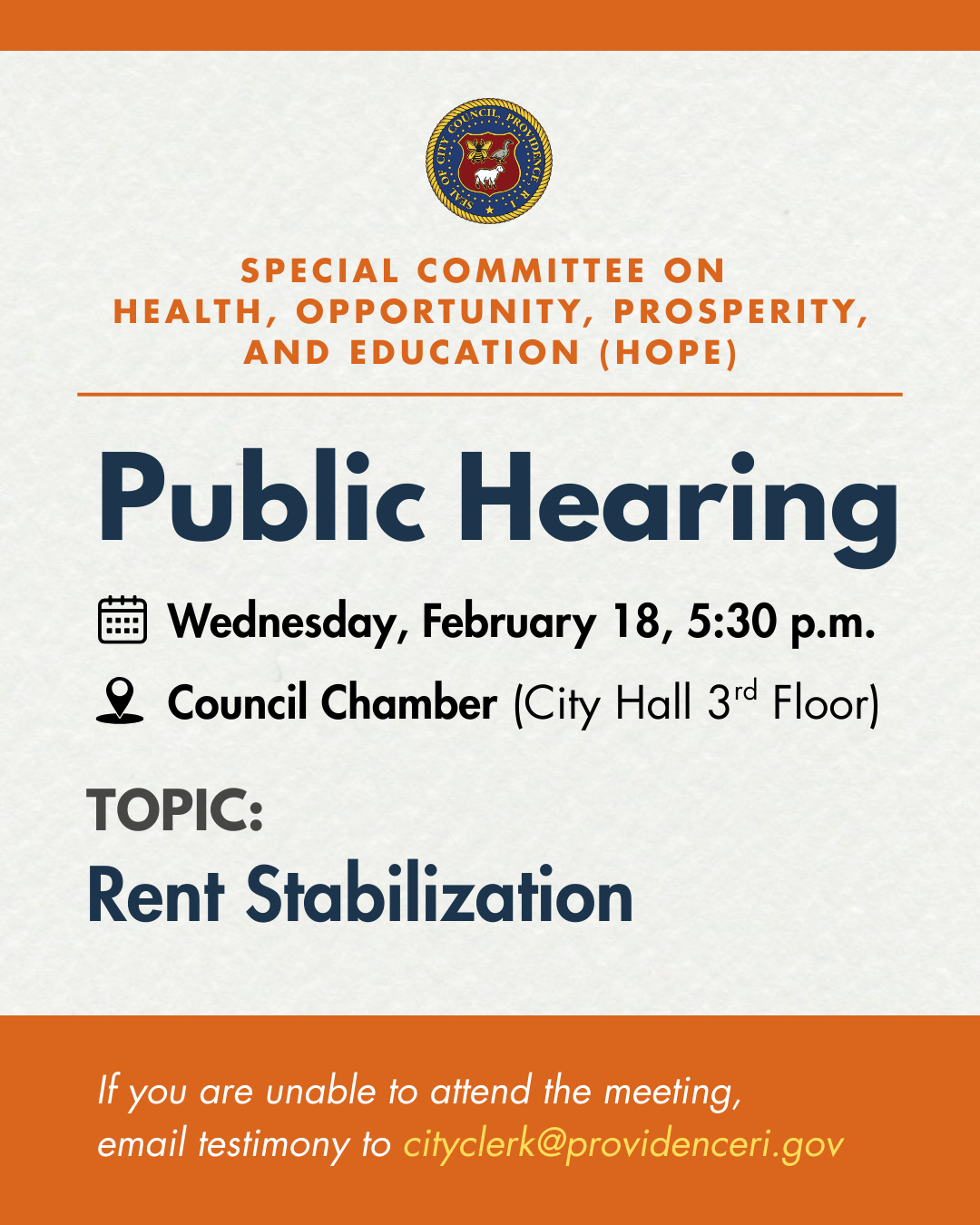
President Pro Tempore Juan M. Pichardo (Ward 9), who chairs the Providence City Council Special Committee on Health, Opportunity, Prosperity, and Education (HOPE), announced that the committee will hold a public hearing on the proposed rent stabilization ordinance. The hearing will be held on Wednesday, February 18, at 5:30 p.m. in the City Council Chamber on the third floor of City Hall. Constituents are encouraged to attend to share their opinions on the ordinance, make suggestions, and hear the thoughts of their neighbors.
“This public hearing marks the beginning of a transparent process where Providence residents can share their experiences, concerns, and ideas about rent stabilization,” said President Pro Tempore Juan M. Pichardo. “Vice Chair Shelley Peterson, our committee members, and I are committed to listening closely to everyone impacted by this proposal—including both renters and homeowners. The strongest policy is always informed by both evidence and the actual experiences of our residents. We look forward to hearing directly from the community as we work toward thoughtful, balanced housing policy for the city we call home.”
The public hearing is one piece of a robust public process that will also include community meetings throughout the city. Under the leadership of Chair Pichardo, the HOPE Committee will carefully consider the public’s input as they continue to vet the ordinance. Following the public hearing, the committee plans to meet on February 23, at 5:30 p.m. to discuss the ordinance and the community feedback received to date. That meeting will not include public comment, and no vote will be taken on the ordinance.