by Council Staff | Feb 5, 2026 | Uncategorized
Providence, RI – Tonight, the Providence City Council held a full meeting in the Council Chamber on the third floor of City Hall.
Councilors unanimously approved a resolution denouncing Immigration and Customs Enforcement’s campaign of aggression around the country, and specifically the unjust killings of Alex Pretti and Renee Good, who were tragically killed by immigration enforcement agents in Minneapolis. As communities organize to support and protect each other from these violent, reckless attacks, Providence councilors extend solidarity and support to the people of Minneapolis.
“Federal officers are leading a campaign of terror in Providence and around the country, violating the constitutional rights of residents en masse,” said Council President Rachel Miller (Ward 13). “Today we stand with Minneapolis, and we rise together to defend democracy here and everywhere by calling on our Congressional delegation to abolish an agency that is perverting the principles of justice and fair treatment under the law.”
As Providence residents continue to report difficulty navigating snow and ice on the city’s streets, several councilors introduced a resolution seeking information, reflection, and accountability on the City’s storm preparation and management. The City Council’s Committee on Public Works held a public meeting with DPW leadership to discuss the handling of the storm on Tuesday, February 3. The resolution, which requests a formal report from the Department of Public Works, was referred to the Committee on Public Works.
“Obviously, a combination of intense snow accumulation, extreme cold, and insufficient resources led to a less-than-stellar response by DPW,” said Councilwoman Shelley Peterson (Ward 14). “I look forward to reading DPW’s report so we can join the Administration in finding ways to improve our storm planning and management in the future.”
In response to reports that many stores in the greater Providence area have sold out of road salt, Councilman Oscar Vargas (Ward 15), who chairs the Committee on Public Works, presented a resolution requesting DPW distribute at least one ton of the city’s salt supply to residents to help clear sidewalks and driveways. The resolution was passed on the floor.
“Unfortunately, over the last week DPW’s plows have pushed snow into constituents’ sidewalks and driveways, causing accessibility issues,” said Councilman Vargas. “We’ve been experiencing extreme cold temperatures, and not all of the snow and ice has melted. With the lack of road salt available for purchase, we’re proposing that DPW provide some of their salt to Providence residents to melt the ice so pedestrians, strollers, and wheelchairs can once again get around safely.”
Councilors also introduced a resolution promoting sustainable and equitable funding for stormwater and sewer management. Providence has experienced 13 significant flooding events in the past three years that have endangered residents and damaged homes and businesses. In response, a Sustainable Stormwater and Sewer Assessment Study Task Force recommended establishing dedicated user fees for stormwater and sewer management. The resolution, which was introduced by Councilor Jill S. Davidson (Ward 2) and Task Force member Councilor Sue AnderBois (Ward 3), supports working in collaboration with the Administration to advance the task force’s recommendations, engage community members, and develop an implementation framework. It was referred to the Special Committee on Environment and Resiliency.
In a continued effort to advocate for safe, affordable housing, councilors heard two resolutions supporting state legislation that addresses housing issues. Councilors unanimously passed a resolution, introduced by Council President Miller, which supports $25 million general obligation housing bonds in the General Assembly. A second resolution introduced by Councilwoman Peterson supports H-7199 and S-2291, which amend the Residential Landlord and Tenant Act to allow victims of domestic violence and sexual abuse to terminate a lease early without penalty or liability. This resolution was referred to the Special Committee on State Legislative Affairs.
Councilors also unanimously approved a resolution introduced by Councilman John Goncalves (Ward 1) recognizing International Holocaust Remembrance Day, which took place on January 27, 2026. January 27th is the anniversary of the day the Red Army liberated the Auschwitz-Birkenau Nazi concentration and extermination camp.
Councilors approved Mayor Brett Smiley’s appointment of Andrew Bramson, President and CEO of Onward We Learn, to the Providence School Board for Region 1. Bramson is currently serving as the Board Chair of the Central Falls School District.
The next city council meeting will take place on February 19th, 2026.
by Council Staff | Feb 3, 2026 | Uncategorized
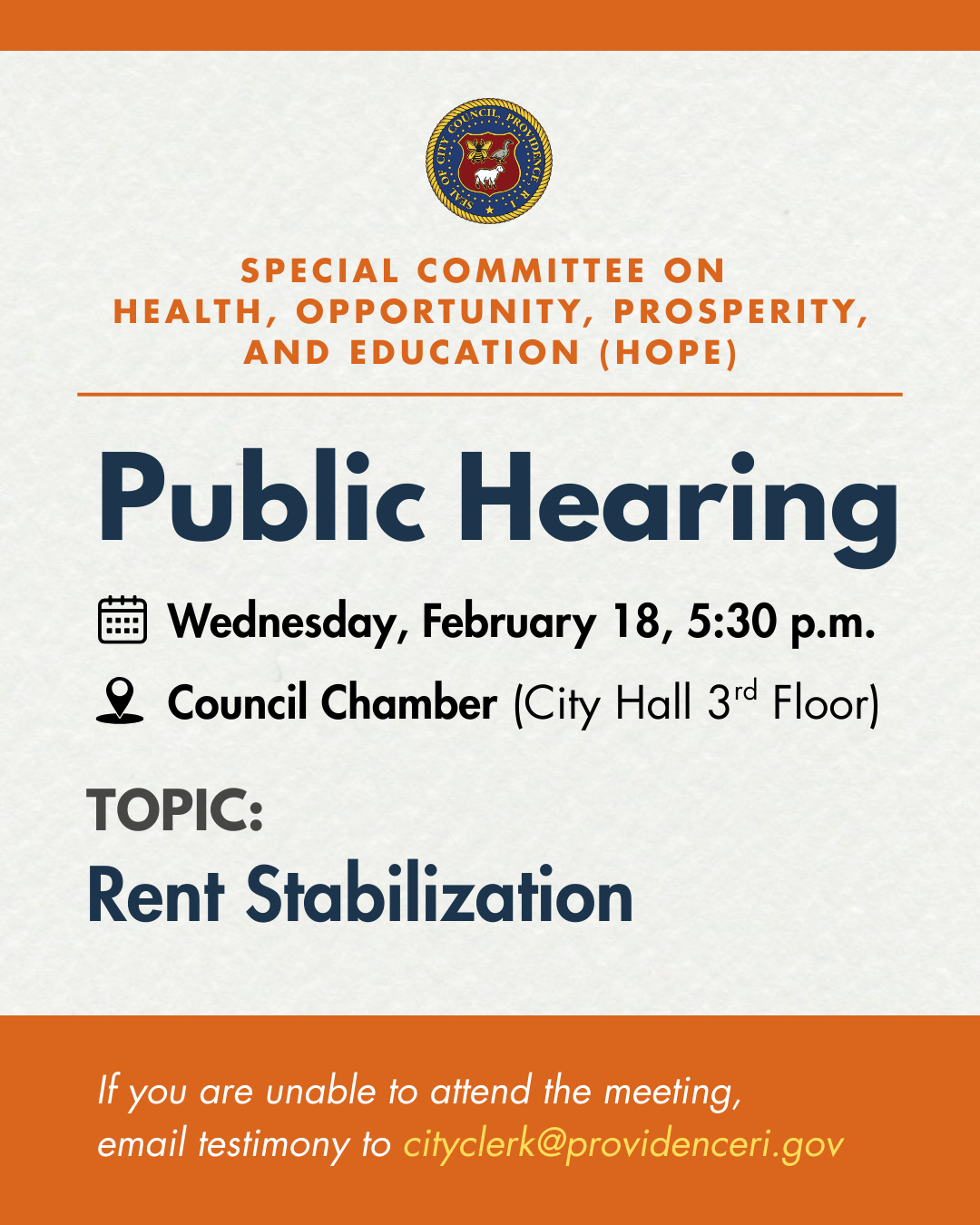
President Pro Tempore Juan M. Pichardo (Ward 9), who chairs the Providence City Council Special Committee on Health, Opportunity, Prosperity, and Education (HOPE), announced that the committee will hold a public hearing on the proposed rent stabilization ordinance. The hearing will be held on Wednesday, February 18, at 5:30 p.m. in the City Council Chamber on the third floor of City Hall. Constituents are encouraged to attend to share their opinions on the ordinance, make suggestions, and hear the thoughts of their neighbors.
“This public hearing marks the beginning of a transparent process where Providence residents can share their experiences, concerns, and ideas about rent stabilization,” said President Pro Tempore Juan M. Pichardo. “Vice Chair Shelley Peterson, our committee members, and I are committed to listening closely to everyone impacted by this proposal—including both renters and homeowners. The strongest policy is always informed by both evidence and the actual experiences of our residents. We look forward to hearing directly from the community as we work toward thoughtful, balanced housing policy for the city we call home.”
The public hearing is one piece of a robust public process that will also include community meetings throughout the city. Under the leadership of Chair Pichardo, the HOPE Committee will carefully consider the public’s input as they continue to vet the ordinance. Following the public hearing, the committee plans to meet on February 23, at 5:30 p.m. to discuss the ordinance and the community feedback received to date. That meeting will not include public comment, and no vote will be taken on the ordinance.
by Council Staff | Jan 22, 2026 | Add Council Logo
Providence, RI — Tonight, a majority of the City Council formally introduced the highly anticipated rent stabilization ordinance. This proposal was announced at an event on Tuesday, January 20th, with Council President Rachel Miller (Ward 13) and President Pro Tempore Juan M. Pichardo (Ward 9), other sponsoring councilors, landlords, renters, and housing advocates. Together, they emphasized the urgent need for this policy proposal. The ordinance was referred to the Special Committee on Health, Opportunity, Prosperity, and Education (HOPE), where there will be a robust public process including considerable opportunity for public input.
Just days after Brown University students returned to campus for the first time since December’s tragic shooting, councilors unanimously approved a resolution recognizing the countless first responders and community members who supported distressed students and neighbors during and after the attack. The heroic, generous efforts of the Providence Police Department, Brown University Department of Public Safety, RIPTA bus drivers, Brown staff, mutual aid networks, and others helped our community navigate this unprecedented tragedy with care and grace.
In addition, councilors unanimously approved a resolution supporting General Assembly legislation to raise the maximum reimbursement from PILOT aid from 27% to 30%, bringing much-needed revenue to the City following last year’s court settlement on school funding. The resolution was introduced by Councilman John Goncalves (Ward 1).
Councilman Goncalves also introduced a resolution urging passage of the 2026 Save RIPTA Legislative package in response to a $10 million budget deficit that affected 45 of the system’s 63 routes and reduced overall service by 15%. If enacted, the package would support the long-term health of the bus system and those who depend on it by providing reliable funding avenues and addressing capital improvement issues. The resolution was referred to the Committee on State Legislative Affairs.
The Council approved a resolution from Councilwoman Jo-Ann Ryan (Ward 5) establishing the Special Commission on the History of the Providence City Council. The commission will be tasked with the preservation of the Council’s institutional, legislative, and structural history, and with assembling and organizing records of the Council’s past actions, development, operation and governance practices to ensure their accessibility to the public and to current and future City leaders.
Rent Stabilization
Providence has the fastest rent growth in the country, even while the national median rent decreased. The median rent in Providence is 40% higher today than it was in 2020. Rising costs have forced working families out of the city and have directly contributed to rising rates of homelessness. Since March 2020, Providence has experienced more than 24,000 evictions. Between 2023 and 2024, Rhode Island experienced a 35% rise in homelessness, the second-highest increase in the country.
Sponsoring councilors developed the ordinance in order to create stability and predictability for Providence renters while supporting a healthy housing market. It allows owners of covered properties to raise rents up to 4% annually, includes exceptions for major tax increases and substantial capital improvements, provides for exemptions for a variety of properties including new construction and small owner-occupied buildings, and establishes a Rent Board to enforce tenant protections, grant exemptions to property owners, and resolve disputes. The ordinance is a balanced, Providence-specific approach—one that stabilizes housing for Providence families while ensuring property owners achieve a fair rate of return.
“Providence renters are cost-burdened—we are the least affordable city for renters in the country. We have to act now to create some stability for Providence families,” said Council President Miller. “This ordinance takes immediate action to give residents the breathing room they need. It stabilizes costs, slows a runaway rent pricing problem that will not regulate itself, and prevents our residents from being forced out of our city, all without slowing growth.”
Notable features of the Providence Rent Stabilization Ordinance include:
- Caps annual rent increases at 4%. A landlord cannot raise the rent by more than 4%, absent a special circumstance, in any 12-month period.
- Sets base rent as the rent charged 180 days before the ordinance takes effect, preventing last-minute price spikes before the law goes into force.
- Establishes a Rent Board to administer and enforce the rules. This five-member board and their staff will review landlord petitions for larger increases, hear tenant complaints, and ensure the ordinance is followed fairly.
- Tenants can report suspected violations and are protected from any landlord retaliation for exercising their rights. The Rent Board can roll back unlawful rent hikes, order landlords to refund overcharged rent, and the City can levy fines for serious violations.
- Exemptions for small, owner-occupied buildings with one to three units, such as duplexes and triple-deckers where the owner lives on-site. A narrow exemption for one additional small property owned by the same individual (not a corporation).
- A 15-year exemption for new construction, including currently existing buildings, to ensure that rent stabilization does not interfere with housing production or financing.
- Built-in flexibility for landlords to address major expenses. Owners can seek approval for a higher rent increase if they make significant capital improvements or have other special circumstances where a larger increase is necessary to ensure they can earn a fair return.
- Automatic flexibility for large property tax increases, allowing landlords to pass on a fair portion of unusually high tax hikes above a 5% threshold using a clear formula.
- Rent can only be increased one time by 4% when a tenant moves out and a new tenant moves in, maintaining stability through vacancies.
- Complaint-based enforcement, allowing tenants to report violations without creating a large new bureaucracy or annual reporting burden on property owners.
- Utility charges must reflect actual costs, ensuring that landlords may only pass through the real price of utilities and not mark them up.
- Properties must be up to code to qualify for annual rent increases, meaning landlords must maintain safe, habitable buildings in order to apply the standard 4% increase.
Since the start of the term in 2023, the City Council has invested $55 million in the City’s Affordable Housing Trust Fund, overhauled the City’s zoning policy to increase density citywide, and incentivized private development through tax stabilization agreements. These policies have brought hundreds of housing units to the City—in both deeply affordable income restricted developments and market rate new construction. The Council has also increased annual budget allocations to the City’s home repair program that provides forgivable no cost loans to residents to maintain their properties and made a one-time $3 million allocation to the program with American Rescue Plan dollars.
Last year, the Council’s Housing Crisis Task Force concluded a two-year investigation into the issues residents—including those at risk of homelessness—face in finding and keeping stable housing with the release of an extensive report, which included rent stabilization among its recommendations.
For answers to commonly asked questions, the councilors sponsoring the ordinance have put together an FAQ, which will be updated on the City Council’s website at council.providenceri.gov/housinghub/rentstabilizationfaq/. You can also read Council President Miller’s opinion piece in The Boston Globe from January 20th on how rent stabilization could help solve Providence’s housing crisis.
by Council Staff | Jan 21, 2026 | Add Council Logo
In an op-ed published in The Boston Globe yesterday, Jan. 20th, City Council President Rachel Miller made the case for rent stabilization in Providence. The ordinance will be introduced officially at tomorrow’s City Council meeting. You can read the full op-ed here or at the Globe web site.
Ask any Rhode Island politician what their top priority is, and you’re likely to get the same answer: Housing.
For us local elected officials, the reason is clear. We hear the same thing from just about every person we speak with: “I can’t afford my rent.”
They’re not alone. Forty-seven percent of Providence renters are now considered “cost burdened,” meaning rent accounts for more than 30 percent of their income. According to an April rent.com report, from March 2023 to March 2024, Providence experienced the highest rent increase in the nation, with average rents rising by 16 percent.
The trend continued in January 2025, when a Redfin report named Providence the single least-affordable city for renters, who make up more than 60 percent of city residents. And, this month, according to apartments.com, the average rent of a 2-bedroom apartment in Providence in January 2026 is $2,603. If you go by the 30 percent rule, a tenant would need to earn $104,120 to afford that much in rent.
We are working hard on long-term solutions.
Since I became Council President in 2023, the Providence City Council has taken serious steps to address the housing shortage fueling much of the crisis. We have invested $55 million in the Housing Trust and lowered the income threshold to ensure this investment goes to those most in need. This funding has already led to hundreds of affordable new units. The Council also advanced zoning changes in the Comprehensive Plan that loosen restrictions on building denser housing, especially along transit corridors.
But building housing at the scale needed takes time, and time is not on our side. Providence families are in crisis. Navigating a full-blown rent emergency can’t wait. We need an immediate stopgap to provide stability for families living in precarity.
That’s where rent stabilization comes in.
Today, I’m introducing an ordinance to cap standard annual rent increases at 4 percent.
We need to slow skyrocketing rents, while the policies and investments we’ve made in new construction come to fruition. We need predictability, so renters know their housing costs from year-to-year and aren’t pushed into homelessness or displaced from their neighborhoods.
And we need to do so responsibly.
That’s why the ordinance I’m introducing balances stability for renters with fair returns for property owners. It exempts new construction and installs a rent board to hear petitions for exceptions in cases of meaningful capital improvements or demonstrated extenuating circumstances that would prevent a fair return. The ordinance also automatically allows property owners to exceed 4 percent in the case of significant property tax hikes.
Recognizing that homeowners renting out the small, one-to-three unit buildings in which they live, plus one additional small building, are part of the solution, not the problem, the ordinance exempts them as well.
This commonsense approach allows us to stabilize costs for renters while maintaining our existing housing stock and supporting small neighborhood landlords, all without slowing down the development we desperately need.
I know the market won’t solve this problem on its own. Meaningful, thoughtful intervention is necessary to protect the interests of Providence families.
I’m a renter myself—a rare breed among elected officials.
In 2022, researchers from Boston University and the University of Georgia analyzed 1,800 city councilors and mayors from 190 cities, including Providence, and found that an estimated 93 percent of them own their homes. As one of the 7 percent of local officeholders who rents, I feel the challenges and the urgency for solutions. It’s my own experience, and that of my neighbors I’m proud to represent, that has led me to take this necessary step.
Rent stabilization is about who we are as a city. Do we want Providence to be a place where you have to be upper middle class just to survive? Or do we want to be a city where artists can pursue their dreams, immigrants can build a thriving future, and union workers aren’t pushed out of the neighborhoods they built? Providence’s strength has always come from its mix—of cultures, of ideas, of people from all walks of life who care about each other and our collective success. Rent stabilization is the next chapter for Providence.
To win meaningful change that creates predictability in the rental market will require solidarity and grit. We are up against big developers and a real estate lobby that will do whatever it takes to maximize profit, even at the expense of family and neighborhood stability. But this is our city. Ours to live in, ours to love, ours to afford.
Now, the rent stabilization ordinance will be thoroughly vetted before it comes to a vote. There will be public hearings, community meetings, conversations in living rooms and on street corners. If you have concerns with aspects of it, I hope you’ll express them. And if you support it, I hope you’ll do so loudly.
Because if we raise our voices together, there is no amount of monied special interest lobbying that can stop us from keeping people in their homes.
by Council Staff | Jan 21, 2026 | Add Council Logo
City Council President Rachel Miller and President Pro Tempore Juan M. Pichardo are set to introduce an ordinance that allows for reasonable annual rent increases while exempting small owner-occupant landlords
Providence, RI – Today in Providence’s Elmwood neighborhood, Providence City Council President Rachel Miller and President Pro Tempore Juan M. Pichardo announced the introduction of a highly anticipated rent stabilization, joined by a large crowd of community members.
“Providence renters are cost-burdened—we are the least affordable city for renters in the country. We have to act now to create some stability for Providence families,” said Council President Miller. “This ordinance takes immediate action to give residents the breathing room they need. It stabilizes costs, slows a runaway rent pricing problem that will not regulate itself, and prevents our residents from being forced out of our city, all without slowing growth.”
The ordinance will create stability and predictability for Providence renters while supporting a healthy housing market. It allows owners of covered properties to raise rents up to 4% annually, includes exceptions for major tax increases and substantial capital improvements, provides for exemptions for a variety of properties including new construction and small owner-occupied buildings, and establishes a Rent Board to enforce tenant protections, grant exemptions to property owners, and resolve disputes. The ordinance is a balanced, Providence-specific approach—one that stabilizes housing for Providence families while ensuring property owners achieve a fair rate of return.
“Most small, local landlords already try to keep rents reasonable and tenants stable,” said Gabe Long, owner-occupant and local landlord. “This ordinance reflects that reality. It sets clear rules, allows flexibility for real costs, and protects renters from extreme hikes, while still making it possible to keep our buildings safe. It gets the balance right, and it makes clear that this housing should be about stability for communities, not profit-maximizing for large corporate landlords.”
Providence has the fastest rent growth in the country, even while the national median rent decreased. The median rent in Providence is 40% higher today than it was in 2020. Rising costs have forced working families out of the city and have directly contributed to rising rates of homelessness. Since March 2020, Providence has experienced more than 24,000 evictions. Between 2023 and 2024, Rhode Island experienced a 35% rise in homelessness, the second-highest increase in the country.
“Rent stabilization is about keeping Providence livable for the people who call it home,” said President Pro Tempore Juan M. Pichardo. “It brings predictability and fairness to a chaotic housing market by putting an end to excessive rent hikes and creating enforceable guardrails on a market that has been out of control for too long. This is a commonsense, Providence-specific approach that protects working families. It gives large property owners a simple path to seek exemptions as necessary, ensuring continued investment in maintenance and repair. And it recognizes that small, local landlords by and large already operate in the framework envisioned by the ordinance—making modest annual rent adjustments to increase costs.”
Councilors point to the introduction of the rent stabilization as the next step in a three-pronged housing strategy—increase the supply of housing at all income-levels, protect the existing housing stock, and stabilize rent prices.
Since the start of the term in 2023, the City Council has invested $55 million in the City’s Affordable Housing Trust Fund, overhauled the City’s zoning policy to increase density citywide, and incentivized private development through tax stabilization agreements. These policies have brought hundreds of housing units to the City—in both deeply affordable income restricted developments and market rate new construction. The Council has also increased annual budget allocations to the City’s home repair program that provides forgivable no cost loans to residents to maintain their properties and made a one-time $3 million allocation to the program with American Rescue Plan dollars.
“Decades of research on housing markets and displacement show that predictable rent increases help families maintain stability and remain in their homes,” said Dr. Eric Hirsch, Professor of Sociology at Providence College. “The market alone has clearly failed to provide meaningful affordability, making public intervention necessary. By establishing clear limits, thoughtful exemptions, and a strong enforcement structure, Providence’s rent stabilization ordinance aligns evidence-based policy with local conditions, giving residents the ability to plan for their futures while supporting a functioning rental market.”
Last year, the Council’s Housing Crisis Task Force concluded a two-year investigation into the issues residents—including those at risk of homelessness—face in finding and keeping stable housing with the release of an extensive report, which included rent stabilization among its recommendations.
The ordinance will be formally introduced at the regular meeting of the City Council at 6 p.m. on Thursday, January 22nd. It will be referred to committee, where there will be a robust public process including considerable opportunity for public input.
Notable features of the Providence Rent Stabilization Ordinance include:
- Caps annual rent increases at 4%. A landlord cannot raise the rent by more than 4%, absent a special circumstance, in any 12-month period.
- Sets base rent as the rent charged 180 days before the ordinance takes effect, preventing last-minute price spikes before the law goes into force.
- Establishes a Rent Board to administer and enforce the rules. This five-member board and their staff will review landlord petitions for larger increases, hear tenant complaints, and ensure the ordinance is followed fairly.
- Tenants can report suspected violations and are protected from any landlord retaliation for exercising their rights. The Rent Board can roll back unlawful rent hikes, order landlords to refund overcharged rent, and the City can levy fines for serious violations.
- Exemptions for small, owner-occupied buildings with one to three units, such as duplexes and triple-deckers where the owner lives on-site. A narrow exemption for one additional small property owned by the same individual (not a corporation).
- A 15-year exemption for new construction, including currently existing buildings, to ensure that rent stabilization does not interfere with housing production or financing.
- Built-in flexibility for landlords to address major expenses. Owners can seek approval for a higher rent increase if they make significant capital improvements or have other special circumstances where a larger increase is necessary to ensure they can earn a fair return.
- Automatic flexibility for large property tax increases, allowing landlords to pass on a fair portion of unusually high tax hikes above a 5% threshold using a clear formula.
- Rent can only be increased one time by 4% when a tenant moves out and a new tenant moves in, maintaining stability through vacancies.
- Complaint-based enforcement, allowing tenants to report violations without creating a large new bureaucracy or annual reporting burden on property owners.
- Utility charges must reflect actual costs, ensuring that landlords may only pass through the real price of utilities and not mark them up.
- Properties must be up to code to qualify for annual rent increases, meaning landlords must maintain safe, habitable buildings in order to apply the standard 4% increase.
For answers to commonly asked questions, the councilors sponsoring the ordinance have put together an FAQ, which will be updated on the City Council’s website at council.providenceri.gov/housinghub/rentstabilizationfaq/.
———————————————————–
Concejales de Providence proponen estabilización de renta para mantener a las familias en sus hogares
La Presidenta del Concejo Rachel Miller y el Presidente Pro Tempore Juan M. Pichardo presentarán una ordenanza que limita los aumentos de renta cada año, mientras no aplica a propietarios locales que viven en sus edificios.
Providence, RI – Hoy, en el vecindario de Elmwood, miembros del Concejo Municipal de Providence la Presidenta del Concejo Rachel Miller y el Presidente Pro Tempore Juan M. Pichardo anunciaron la introducción de una esperada propuesta de estabilización de renta, acompañados por una gran cantidad de residentes de la comunidad.
“Los inquilinos de Providence están sobrecargados por los altos costos — somos la ciudad menos asequible para los que alquilan en todo el país. Tenemos que actuar ahora para darles a las familias algo de estabilidad,” dijo la Presidenta del Concejo Rachel Miller. Esta ordenanza estabiliza los costos, frena un aumento descontrolado de las rentas y evita que nuestros residentes se vean obligados a abandonar la ciudad, todo sin frenar el crecimiento de nueva construcción.”
Esta propuesta busca dar estabilidad a los inquilinos, mientras mantiene un mercado de vivienda saludable. Para las propiedades a las que aplica esta ordenanza, se permiten aumentos de renta de hasta un 4% al año, con excepciones para incrementos grandes de impuestos y mejoras importantes a los edificios. Quedan fuera ciertos tipos de propiedades, como construcciones nuevas y edificios pequeños donde el propietario vive allí. Además, se establece una Comisión de Renta para supervisar el cumplimiento de la ley, resolver disputas, proteger a los residentes que alquilan y a los propietarios, así como permitir excepciones en casos específicos. Es un enfoque balanceado, diseñado específicamente para Providence.
“La mayoría de los propietarios locales ya mantienen las rentas razonables,” dijo Gabe Long, propietario que vive en su edificio. “Esta ley pone reglas claras, permite flexibilidad cuando hay costos reales, y protege a los inquilinos de aumentos extremos, mientras garantizando que los edificios se mantengan seguros y habitables. Este enfoque logra un equilibrio adecuado: protege la estabilidad de las comunidades, y deja claro que la vivienda debe enfocarse en el bienestar de los vecinos, y no en maximizar ganancias para grandes corporaciones.”
Providence tiene el crecimiento de renta más rápido del país, mientras que la renta promedio nacional ha disminuido. Hoy, la renta promedio en la ciudad es un 40% más alta que en 2020, lo que ha obligado a muchas familias trabajadoras a mudarse y ha contribuido al aumento de las personas sin hogar. Desde marzo de 2020, se han registrado más de 24,000 desalojos forzados, y entre 2023 y 2024, la cantidad de personas sin hogar en Rhode Island creció un 35%, el segundo mayor incremento del país.
“La estabilización de la renta se trata de mantener Providence habitable para las personas que lo llaman su hogar,” dijo el Presidente Pro Tempore Juan M. Pichardo. “Brinda estabilidad y justicia a un mercado de vivienda caótico, poniendo fin a los aumentos excesivos de renta y estableciendo límites claros en un mercado que ha estado fuera de control por demasiado tiempo. Es un enfoque de sentido común, adaptado específicamente a Providence, que protege a las familias trabajadoras. Además, ofrece a los grandes propietarios un camino sencillo para solicitar excepciones cuando sea necesario, garantizando que se siga invirtiendo en mantenimiento y reparaciones. Reconoce, asimismo, que los propietarios locales, en general, ya operan de manera similar a lo que propone esta ordenanza, haciendo ajustes anuales modestos en las rentas.”
Los concejales señalan que la introducción de la estabilización de rentas es el siguiente paso dentro de una estrategia de vivienda en tres frentes: aumentar la oferta de viviendas para todos los niveles de ingresos, proteger el inventario de viviendas existente y estabilizar los precios de renta.
Desde 2023, el Concejo Municipal ha invertido 55 millones de dólares en el Fondo de Viviendas Asequible de la ciudad, ha reformado las políticas de zonificación para aumentar la densidad en toda la ciudad y ha incentivado el desarrollo privado mediante acuerdos de estabilización de impuestos. Estas políticas han traído cientos de unidades de viviendas a la ciudad, tanto en proyectos de vivienda profundamente asequible como en construcciones nuevas a precio de mercado. El Concejo también ha incrementado los fondos anuales para el programa de reparación de viviendas, que otorga préstamos perdonables sin costo a los residentes para mantener sus propiedades, y ha hecho una asignación única de 3 millones de dólares al programa con fondos del American Rescue Plan.
“Décadas de investigaciones sobre los mercados de vivienda y el desplazamiento muestran que aumentos de renta predecibles ayudan a las familias a mantener estabilidad y a permanecer en sus hogares,” dijo el Dr. Eric Hirsch, profesor de Sociología en Providence College. “El mercado por sí solo claramente ha fallado en ofrecer una verdadera asequibilidad, por lo que la intervención pública es necesaria. Al establecer límites claros, excepciones bien pensadas y un sistema de cumplimiento sólido, la ordenanza de estabilización de rentas de Providence aplica políticas basadas en evidencia a nuestra realidad local, dando a los residentes la posibilidad de planificar su futuro mientras se mantiene un mercado de alquiler funcional.”
El año pasado, el Grupo de Trabajo sobre la Crisis de Vivienda del Concejo completó una investigación de dos años sobre los problemas que enfrentan los residentes —incluyendo quienes están en riesgo de quedarse sin hogar— para encontrar y mantener una vivienda estable, y publicó un extenso informe que incluyó la estabilización de rentas entre sus recomendaciones.
La ordenanza será presentada oficialmente en la reunión del Concejo Municipal el jueves 22 de enero a las 6:00 p.m. Luego pasará a comité, donde habrá un proceso público con muchas oportunidades para que la comunidad participe.
Puntos clave de la Ordenanza de Estabilización de Renta:
- La renta no puede subir más de 4% en 12 meses, excepto en casos especiales.
- Establece la renta base como la renta cobrada 180 días antes de que la ordenanza entre en efecto, evitando aumentos de último minuto.
- Crea una Comisión de Renta para administrar y hacer cumplir la ley. Sus cinco miembros y su personal revisarán las solicitudes de aumentos mayores por parte de los propietarios, atenderán quejas de los inquilinos y se asegurarán de que la ordenanza se cumpla de manera justa.
- Los inquilinos pueden reportar violaciones sin temor a acciones en su contra de los propietarios. La Comisión de Renta puede revertir aumentos ilegales, ordenar reembolsos por renta cobrada en exceso y la ciudad puede imponer multas por infracciones graves.
- Exenciones para edificios pequeños ocupados por sus dueños, de una a tres unidades, como dúplex o triple-deckers donde el dueño vive en la propiedad.
- También hay una exención limitada para una propiedad adicional pequeña del mismo propietario (no corporativa).
- Exención de 15 años para construcciones nuevas, incluidas las existentes, para asegurar que la estabilización de rentas no interfiera con la producción o financiación de viviendas.
- Flexibilidad incorporada para que los propietarios puedan cubrir gastos importantes. Los propietarios pueden solicitar un aumento mayor si realizan mejoras de capital significativas u otras circunstancias especiales que hagan necesario un incremento más alto para obtener un retorno justo.
- Flexibilidad automática para grandes aumentos de impuestos a la propiedad, permitiendo que los propietarios trasladen una parte justa de incrementos por encima del 5% utilizando una fórmula clara.
- La renta solo puede incrementarse una vez en 4% cuando un inquilino se muda y entra uno nuevo, manteniendo estabilidad durante los cambios de ocupante.
- Permitiendo a los inquilinos reportar violaciones sin crear una gran burocracia nueva ni cargas anuales para los propietarios.
- Los cargos por servicios públicos deben reflejar el costo real, evitando que los propietarios los aumenten por encima del precio pagado.
- Las propiedades deben cumplir con el código de construcción para calificar para los aumentos anuales, asegurando que los edificios sean seguros y habitables antes de aplicar el aumento estándar del 4%.
Para respuestas a preguntas frecuentes, los concejales patrocinadores de la ordenanza han preparado un FAQ, que se actualizará en el sitio web del Concejo Municipal: council.providenceri.gov/housinghub/rentstabilizationfaq.

by Council Staff | Jan 15, 2026 | Ward-1
Dear Neighbors,
A little over a month ago, our community was shaken by the shooting on Brown University’s campus in the heart of Ward 1. As I reflect on the aftermath of this tragedy, I continue to feel profoundly grateful for the way our communities came together in a time of unspeakable grief and fear. Together, we are forging a path forward with care and compassion.
In support of small businesses impacted in the aftermath of this horrific event, the Providence City Council partnered with the mayor’s administration, Rhode Island Commerce, and Brown University to offer a total of $45,000 in grants for merchant associations. Three $15,000 grants will be awarded to the Thayer District Merchant Association, the Wickenden Area Merchant Association, and the Wayland Square Merchant Association. With these funds, businesses can explore opportunities that stabilize foot traffic, bolster the comfort of customers, and implement other recovery initiatives.
As our community continues to heal, and Brown students return to Providence in the coming weeks, I am dedicated to continue investing in the resilience of our community. It is an honor to represent you and our neighborhood. Thank you for being an engaged neighbor.
Warmly,
John Goncalves
Ward 1 Councilman
Senior Deputy Majority Leader
by Council Staff | Dec 17, 2025 | Add Council Logo
Tonight, Providence City Council members convened for the swearing-in of Councilor Jill S. Davidson (Ward 2) as part of a special council meeting. Councilors also took the opportunity to hold the victims of the Brown University shooting this past weekend in their prayers.
Councilors honored the memories of Brown students Mukhammad Aziz Umurzokov and Ella Cook, and acknowledged the others injured in the shooting, the first responders working tirelessly since Saturday, and everyone impacted by the past weekend’s tragedy.
“We come together tonight with heavy hearts… We ask for healing for those who were injured and peace for all who were shaken,” said Councilman John Goncalves (Ward 1). “Providence has faced hardship before, and each time we’ve shown who we are. We are resilient. We look out for each other. We don’t turn away from pain, and we don’t allow fear to define us.”
“We have a profound obligation to our constituents to pursue the truth,” added Council President Rachel Miller (Ward 13), encouraging her fellow councilors to help stop the spread of misinformation in support of the ongoing investigation. “Our office is here to serve you, to provide any information your constituents might need.”
Councilor Davidson won the Ward 2 special election on December 3rd. The election followed the September resignation of her predecessor, Councilwoman Helen Anthony. Ward 2 includes the College Hill, Wayland, and Blackstone neighborhoods, including much of Brown University’s campus. Councilor Davidson and her husband Kevin have lived in the Blackstone neighborhood in Providence for more than 20 years and are the proud parents of three adult sons.
“This has been an extraordinarily difficult week for Ward 2,” said Councilor Davidson. “I feel immensely grateful that I can be there for my neighbors at this time and look forward to continuing to serve my community in the new year.”
Councilor Davidson currently serves as Director of Development and Communications at the Woonasquatucket River Watershed Council and serves on the boards of the Center for Leadership and Educational Equity and the Association of Fundraising Professionals Rhode Island Chapter. She has held long-term leadership positions with multiple parent-teacher organizations in Providence, including Dr. Martin Luther King Jr. Elementary School PTO, Nathan Bishop Middle School PTO, and the Classical High School Community Association.
Councilor Davidson received her A.B. from Brown University and her M.Ed. from the Harvard Graduate School of Education. Visit Davidson’s profile for more information.
Councilors also granted second and final passage to an ordinance supporting the Mile of History project, which authorizes financing for major infrastructure upgrades to Benefit Street, known as one of Providence’s most historic corridors. Benefit Street and its accompanying attractions see 300,000 tourists each year. Nearly 40% of the stretch of sidewalk has been determined to be difficult to traverse, while over 300 feet is considered impassable. The project will repair cracked sidewalks, replace missing bricks, restore tree wells, and ensure ADA accessibility.
“I am deeply grateful to all of the partners who made this possible, including Council President Miller, Chairwoman Jo-Ann Ryan (Ward 5), Mayor Smiley and the administration, the Mile of History, and all of my colleagues who believed in the merits of this project,” said Councilman Goncalves. “This bond is not just for the East Side. It represents an economic investment in one of the most historically significant streets in our country, which truly benefits every neighborhood, every resident and every visitor to our great city. I look forward to working with my colleagues and advocating tooth-and-nail to ensure this is one of many meaningful infrastructure and sidewalk improvements in neighborhoods across Providence.”
The meeting also included appointments, reappointments, and elections to the Juvenile Hearing Board, Providence External Review Authority, Green and Complete Streets Advisory Council, Probate Court, and the Sustainability Commission.
The meeting adjourned with a moment of silence for Umurzokov and Cook.
The first regularly scheduled council meeting of 2026 will take place on Thursday, January 8, 2026.
by Council Staff | Dec 16, 2025 | Add Council Logo
Providence, RI – On Wednesday, December 17 at 5 p.m., Providence City Council will convene for a special meeting in the Council Chamber on the third floor of City Hall. It will begin with the swearing-in ceremony of Councilor-elect Jill S. Davidson (Ward 2). Press and the public are invited to attend.
During the special meeting, councilors will also vote on second passage of the Mile of History project, which provides for infrastructure improvements along and adjacent to historic Benefit Street and consider end-of-year appointments to city boards and commissions.
by Council Staff | Dec 4, 2025 | Add Council Logo
At tonight’s City Council meeting, councilors unanimously voted to approve the City’s lease of the WaterFire Arts Center back to WaterFire Providence, and advanced an ordinance supporting the Mile of History project.
“This vote is about protecting the heartbeat of Providence, a cultural event that has become synonymous with the city itself,” Chairwoman Jo-Ann Ryan (Ward 5) shared in a release after the November 5th Finance Committee meeting. “WaterFire is more than a world-renowned art installation, it’s an engine of economic activity, drawing in about $162 million of economic stimulus to Rhode Island annually. This agreement is a smart, forward-looking decision that will pay dividends for Providence residents, businesses, and visitors for years to come.”
Chairwoman Ryan also authored an op-ed published in The Providence Journal detailing the community and financial benefits of investing in WaterFire. Their programming not only brings roughly a million visitors to the city annually, it also supports local artists by offering workforce support and vending opportunities.
Councilors granted first passage to an ordinance supporting the Mile of History project, which authorizes financing for major infrastructure upgrades to Benefit Street, known as one of Providence’s most historic corridors. Benefit Street and its accompanying attractions see 300,000 tourists each year. Nearly 40% of the stretch of sidewalk has been determined to be difficult to traverse, while over 300 feet is considered impassable. The project, if passed for a second time, will repair cracked sidewalks, replace missing bricks, restore tree wells, and ensure ADA accessibility.
Following the final vote tally in the general election for the Ward 2 Council seat, the Council has tentatively scheduled a swearing-in ceremony for Jill Davidson on Wednesday, December 17th, at 5:30 p.m. in the Council Chamber on the third floor of City Hall.
Due to the New Year’s holiday, the next regularly scheduled council meeting will take place on Thursday, January 8, 2026.
by Council Staff | Dec 4, 2025 | Add Council Logo
Today, December 4th, at 6 p.m., Providence City Council will convene for a full meeting in the Council Chamber on the third floor of City Hall. Press and the public are invited to attend.
After being voted out of the Committee on Finance with a recommendation to pass, councilors will hear the City’s lease of the WaterFire Arts Center back to WaterFire Providence and an ordinance supporting the Mile of History project, which authorizes financing for infrastructure improvements along and adjacent to the historic Benefit Street.