by Council Staff | Apr 2, 2026 | Add Council Logo
Citywide results align with previous statewide polling and reinforce demand for action on rental costs.
Providence, RI – A new poll reported in the Boston Globe shows strong support for rent stabilization in Providence, with 74% of likely Democratic voters saying they support limiting annual rent increases to 4 percent.
“This poll confirms what we have heard consistently throughout this entire process,” said Council President Rachel Miller. “After years of being squeezed for every dollar possible, Providence renters are demanding stability, predictability, and fairness in the rental market. At every listening session, in hundreds of emails, and through countless hours of public testimony, people have made their voices loud and clear: rent stabilization is needed.”
“This polling shows a broad, citywide consensus, following another poll that shows a broad, statewide consensus,” Miller continued. “We’ve responded to that community pressure by developing a rent stabilization policy unique to Providence—one that targets large, corporate landlords while supporting local, mom-and-pop property owners. We’ve taken the time to engage the community, incorporate feedback, and build a balanced ordinance that protects tenants from unexpected rent increases they simply cannot afford.”
The results are consistent with a 2025 poll conducted by the University of Rhode Island, which found that 72% of Rhode Islanders support limits on rent increases.
“For months, we’ve heard from well-funded special interests telling us rent stabilization would be a disaster,” said Councilor Miguel Sanchez (Ward 6). “The opposition to stabilizing rents is loud, but it’s small. It’s being driven by corporate landlords and ultra-wealthy developers who profit from keeping rents high. This poll cuts through the noise. It shows that the rest of us who are actually living through the housing crisis, whose rents are rising much faster than our paychecks, overwhelmingly support rent stabilization.”
“The free market works very well for a few, and very poorly for everyone else who can’t afford to stay in their home,” Sanchez continued. “This poll makes it clear: the people of Providence are ready for change, and we have a responsibility to deliver it.”
City Council sponsors say the polling underscores the urgency of addressing rising housing costs and reinforces the need for a balanced, Providence-specific approach to rent stabilization. The full City Council is expected to vote for the first time on the rent stabilization ordinance at tonight’s meeting.
by Council Staff | Apr 1, 2026 | Add Council Logo
Providence, RI – Today, at a press conference, City Council President Rachel Miller (Ward 13), Deputy Majority Leader Mary Kay Harris (Ward 11), and non-profit housing developers announced the Boosting Urban Investment to Launch Development (BUILD) Act, legislation that would tax properties offering affordable housing units appropriately from the start, not just upon occupancy, in order to ramp up housing supply.
“The BUILD Act paves the way for the speedy development of affordable income-restricted housing,” said Council President and Act sponsor Rachel Miller. “At a time when our housing crisis requires a swift response, removing process barriers and ensuring that low-income housing developers have what they need to make the financing case has a big impact in the low-income landscape. This is another strong step forward as the Council works to increase development, protect the housing stock, and stabilize the cost of rent.”
“We appreciate the Providence City Council’s recognition that successful affordable housing development depends on predictability and consistency, as demonstrated by the introduction of this ordinance to provide property tax considerations during the development phase,” said Melina Lodge, Executive Director of Housing Network RI. “By reducing uncertainty and allowing developers to focus resources on building homes, this policy meaningfully eases financial pressures while fostering greater efficiency and innovation.”
“Importantly, the added predictability these tax considerations provide enables more reliable planning and execution, helping to accelerate the delivery of much-needed housing for individuals and families,” Lodge continued. “We commend the City Council for its leadership and continued commitment to creating a stable, supportive environment that advances sustainable growth and expands access to affordable housing.”
Currently, low-income housing is subject to a special tax rate, where municipalities assess their properties’ taxes at 8% of their gross scheduled rental income. However, the “8 Law,” as this provision is known, only goes into effect upon occupancy of the rental units. In between the start of construction and initiation of rent, properties are taxed at the regular rate. This is especially problematic when unexpected delays arise, forcing low-income housing developers—who already operate on thin margins—to face tax bills they may not be able to afford.
The BUILD Act will change that, using the tax stabilization agreement (TSA) structure to provide limited stabilization during that gap time before the 8% tax treatment goes into effect. By removing the tax burden from the start, the BUILD Act would clear a difficult barrier to the construction of more affordable housing, especially the deeply affordable housing needed by the lowest income households.
Alongside efforts to increase housing production, Council President Miller and President Pro Tempore Juan M. Pichardo (Ward 9) are advancing rent stabilization to protect tenants from sudden and unsustainable rent increases. According to the sponsors, addressing the housing crisis requires both building more homes and ensuring they remain affordable to the people of Providence. The Council has taken a host of other actions to help increase the supply of housing that is affordable to working-class residents from allocating tens of millions of dollars in new funding for the Providence Housing Trust Fund to prioritizing inclusionary zoning policies in the 2024 Comprehensive Plan. The Council also created a requirement for the Housing Trust Fund to be used strictly for low- and moderate-income housing (below 80% AMI). To learn more about the City Council’s work to combat the housing crisis through increasing housing supply, protecting our housing stock, and stabilizing rent, visit the Housing Hub.
The BUILD Act will be formally introduced at tomorrow evening’s City Council meeting on the third floor of City Hall. The Act can be viewed in full on the Open Meetings Portal.
by Council Staff | Mar 26, 2026 | Add Council Logo
Providence, RI – Tonight, the Providence City Council’s Special Committee on Health, Opportunity, Prosperity, and Education (HOPE) voted unanimously to advance the proposed rent stabilization ordinance out of committee, recommending passage with amendments shaped by months of public engagement and policy research.
The committee’s recommendation follows a robust public process that included community listening sessions across Providence, more than seven hours of public testimony before the full committee, and over 900 written comments submitted to the City Clerk. Feedback from tenants, property owners, housing advocates, nonprofit developers, and policy experts directly informed a series of amendments that strengthened and clarified the proposal.
“We’ve taken the time to do this right,” said President Pro Tempore Juan M. Pichardo (Ward 9). “We committed ourselves to an open, deliberate process, spending years listening to residents, engaging with stakeholders, and grounding our work in research. The result is a balanced ordinance we are proud to recommend to the full Council—one that brings stability to renters while ensuring property owners can continue to maintain and invest in their buildings. It responds with urgency that matches the scale of the housing crisis, and with deep care for everyone affected, both renters and small, local landlords.”
Prior to the vote, the committee heard a virtual presentation from Tram Hoang, the Senior Housing Associate at PolicyLink. Hoang, a national expert on rent stabilization and tenant protections, gave her testimony as part of the sponsors’ continued effort to ground the ordinance in research and best practices.
The amended ordinance limits excessive rent increases, bringing predictability and stability to renters while maintaining clear pathways for property owners to address legitimate operating costs and invest in their buildings. Council sponsors emphasized that the ordinance is part of a broader housing strategy that includes increasing housing supply, protecting existing housing stock, and stabilizing rent costs for Providence residents. Changes made during the committee process include strengthened Rent Board procedures, clearer standards for substantial rehabilitation, and updates to the treatment of new construction.
The members of the committee are Juan M. Pichardo, Shelley Peterson, Miguel Sanchez, Justin Roias, and Sue AnderBois. The ordinance will receive its first consideration by the full City Council at its April 2 meeting. The proposal must be approved twice by a majority of the Council before being sent to the Mayor for signature.
by Council Staff | Mar 19, 2026 | Add Council Logo
Providence, RI – Tonight, Providence City Council held a full meeting in the Council Chamber on the third floor of City Hall, where councilors presented several ordinances and resolutions on the topic of housing.
Councilman John Goncalves (Ward 1) introduced a Rent Housing Subsidy Ordinance, which would establish the Rental and Essential Needs Transition, or RENT Fund, and provide up to $3,000 in emergency one-time financial assistance to households at imminent risk of housing loss, shut-off of utilities, or insurance coverage loss. As written, the $800,000 in rental assistance funds would help up to 300 Providence households. This measure was announced earlier this week at a press conference with Mayor Brett Smiley and members of the City Council.
“Families can scrimp and save, plan and budget, but unexpected emergencies happen,” said Councilman Goncalves. “We created the RENT Fund because evictions ruin people’s lives. This fund will provide short-term relief to help struggling tenants through those moments of crisis so they can stay in their homes and communities.”
Like last year’s rental algorithm price-setting ban and the current proposed rent stabilization ordinance, the creation of an emergency eviction prevention fund is a recommendation from the 2025 Housing Crisis Task Force Report. According to the report, “[e]ven modest, one-time rental assistance payments have been shown to prevent displacement, stabilize families, and reduce the need for costly emergency shelter and rehousing services.”
The ordinance, which is sponsored by all 15 councilors, was referred to the Committee on Finance.
Councilors passed a resolution on the floor in opposition to H-8006, a Rhode Island State bill that would expand “8-Law,” which was originally designed to ensure fair and consistent taxation for low-income housing, to allow commercial-to-residential projects to qualify for a tax break if just 10% of the units in it are affordable to households making up to 120% of the area median income. The resolution raises concerns that the proposal undermines municipal taxing authority and shifts the burden onto local taxpayers.
“Workforce housing, while critically important, is not low-income housing, and municipalities cannot afford to tax it as if it were,” said Council President Rachel Miller (Ward 13). “Conversions are highly expensive, and the City Council is a willing partner in providing appropriate subsidies to enable them, provided that the granting authority rests with municipalities. As written, this bill would subsidize the wealthiest developers in the state while shifting the burden onto homeowners and other property owners.”
Earlier this month, Council President Miller sent a letter of opposition to the Committee on Municipal Government and Housing. The full letter is available upon request.
Councilors heard another ordinance in line with recommendations from the Housing Crisis Task Force Report. Councilwoman Shelley Peterson (Ward 14), who led the Student Housing Task Force for about two years, introduced an amendment to the zoning ordinance establishing Student Housing Overlay Districts. The ordinance would create overlay districts to allow for higher-density off-campus student housing in designated areas surrounding colleges, while establishing a clear review process and standards to protect surrounding neighborhoods from overconcentration and gentrification. It is designed to ensure community voices are heard and considered in the development process, and to better plan, manage, and align student housing growth with the needs of the broader neighborhood beyond the immediate surrounding streets.
“Providence is very much a college town, so we need to protect our neighborhoods while accommodating student housing needs,” said Councilwoman Peterson. “This overlay district will help the city manage student housing density in a way that works for long-term Providence residents as well.”
The proposed ordinance was referred to the Special Committee on Health, Opportunity, Prosperity, and Education (HOPE Committee).
Councilors also heard a resolution in support of deed fraud protection bills at the General Assembly. President Pro Tempore Juan M. Pichardo (Ward 9) worked on related legislation during his tenure as a Rhode Island State Senator. The resolution was referred to the HOPE Committee.
Several additional resolutions supporting state legislation, including many that focused on childcare, were referred to the Special Committee on State Legislative Affairs.
The next regular City Council meeting will convene on April 2, 2026.
by Council Staff | Mar 12, 2026 | Add Council Logo
Today, Providence City Council sponsors of the proposed rent stabilization ordinance announced a slate of amendments shaped by extensive public engagement, policy research, and stakeholder feedback.
The amendments respond to suggestions and feedback raised during multiple community listening sessions throughout the city, a public hearing that lasted more than five hours, and more than 700 written comments submitted to the City Clerk. Councilors also reviewed feedback from the Mayor’s administration, and from organizations including RIHousing, Stop Wasting Abandoned Property Inc. (SWAP Inc.), and the American Civil Liberties Union of Rhode Island (ACLU of Rhode Island).
The amendments clarify exemptions, elaborate on Rent Board procedures, address substantial rehabilitation and utility cost issues, and revise the ordinance’s treatment of new construction. Taken together, the proposed amendments fine-tune the ordinance, while preserving its central goal of ensuring rent increases are stable and predictable for tenants while maintaining clear pathways for property owners to address legitimate operating costs.
“Good policy is built through listening and careful refinement,” said Council President Rachel Miller. “Over the past several months, the ordinance has been shaped by the people who will live with it. We’ve heard from renters, nonprofit developers, property owners, and policy experts. These amendments reflect what we learned. They strengthen the proposal while keeping its core purpose intact: bringing stability to Providence’s rental market while ensuring property owners have the flexibility they need to maintain and invest in their buildings.”
The public is invited to submit additional comments on the proposed amendments or share their feedback at the Tuesday, March 17 meeting of the Special Committee on Health, Opportunity, Prosperity, and Education (HOPE) at 6 p.m. on the third floor of City Hall.
The following are key highlights of the proposed amendments.
New Construction Exemptions
The amendments modify the ordinance’s new construction exemption in several significant ways.
First, the base exemption period for new construction has been reduced from 15 years to 10 years. This preserves a fair transition period for new development while ensuring that units enter the rent stabilization framework within a reasonable timeframe.
Second, a longer 20-year exemption is made available for developments that meet strong labor standards. Projects where workers are paid prevailing wages and where at least 10% of total project hours are performed by registered apprentices will qualify for the longer exemption. This approach provides a pathway to a longer exemption for projects that create high-quality construction jobs, invest in local workers, support apprenticeship pipelines, and strengthen the state’s skilled building trades.
Third, the retroactive application of the exemption has been narrowed. Instead of applying to buildings up to 15 years old, the exemption will now apply only to units that received certificates of occupancy within five years prior to the ordinance’s effective date.
Together, these changes ensure that the exemption supports continued housing development while also strengthening local labor standards.
Affordable Housing Exemptions
The ordinance’s affordable housing exemptions have been revised based on feedback from nonprofit housing developers.
The updated language replaces the original provisions with clearer exemptions for deed-restricted affordable housing and publicly operated or project-based subsidized housing. These are clarifying amendments that match the language to the original intent.
The revised language incorporates the definition used in Rhode Island’s Low and Moderate Income Housing Act, which reflects the typical 30-year affordability restrictions used in most housing programs. It also distinguishes project-based assistance from tenant-based vouchers, which do not limit rent and therefore should not be exempted from the ordinance.
The amendments also direct the Executive Director of the Rent Board to maintain a limited registry of exempt units for transparency and administrative clarity.
Substantial Rehabilitation
The amendments add a clear definition and process for substantial rehabilitation, addressing concerns raised by RIHousing about how the ordinance would treat major renovation projects.
Substantial rehabilitation is defined as a comprehensive renovation that replaces or significantly upgrades at least two major building systems and where construction costs reach at least 15% of the property’s post-rehabilitation value. Cosmetic improvements, routine maintenance, or finish upgrades do not qualify. The amendments establish a process that allows property owners to petition the Rent Board to establish a new base rent for the first tenancy after a qualifying rehabilitation project is completed. In technical terms, it provides for the possibility of one-time vacancy decontrol in the case of substantial rehabilitation.
Utilities and Master-Metered Buildings
The sponsors also addressed concerns raised about master-metered buildings, where utilities are not separately metered and billed by apartment. This is common in older housing stock.
The ordinance already allows landlords to petition the Rent Board for above-standard rent increases based on documented operating cost increases, including utilities. To ensure this issue receives appropriate attention, the amendments now direct the Rent Board to specifically address relief for landlords of master-metered buildings in its rulemaking procedures.
Strengthening Rent Board Procedures
Several amendments clarify how the Rent Board will operate and adopt regulations.
These updates respond to feedback from the ACLU of Rhode Island and many individual testimonies. The amendments add advance notice requirements, a public comment period, a petition process allowing Providence residents to request rulemaking, and a limited emergency rule procedure. Additional changes clarify the roles of the Rent Board and its Executive Director, ensuring a clear distinction between the Board’s policy rulemaking authority and the Director’s day-to-day administrative procedures, and that the Board’s authority is final in the event of a conflict.
As the Council models a robust public feedback process on this ordinance, these changes signal to an incoming board the sponsors’ expectations that transparency and community engagement continue in earnest through the rulemaking process.
Budgetary, Legal, Administrative, and Minor Updates
Additional amendments make several technical, legal, and budgetary improvements to the ordinance.
The amendments establish compensation for Rent Board members, with a stipend starting at $10,000 per year for members and $12,000 per year for the chair. Limited compensation for the Board members is intended to recognize their unique and critical role in the ordinance’s successful enforcement.
In private meetings and public testimony, Mayor Smiley and his administration repeatedly criticized a line in the ordinance that Board funds “be sufficient to ensure full implementation of the Board’s duties.” The amendments remove this line to avoid creating an enforceable statutory obligation that the city cannot guarantee. Removing it does not in any way prevent nor discourage City Council from fully funding the Board with the resources it would need to be successful.
The amendments also modestly expand the owner-occupied exemption from properties with up to three units to properties with up to four units. This aligns the ordinance with federal mortgage standards used by programs administered by RIHousing, which treat owner-occupied properties with up to four units as small residential properties eligible for first-time homebuyer financing. This is intended to ensure the policy does not discourage owner-occupants from purchasing small multifamily homes.
A provision related to misinformation was removed following guidance from the ACLU of Rhode Island to avoid potential First Amendment concerns.
A complete redline of the proposed amendments is available here.
These amendments reflect months of research, community engagement, and policy refinement. Sponsors believe the updated ordinance represents a balanced, Providence-specific approach to addressing rising housing costs—providing stability and predictability for renters while ensuring property owners retain the ability to successfully manage their properties. As the proposal continues through the Council process, sponsors remain committed to a thoughtful public dialogue about how Providence can build more housing while protecting the residents who call the city home.
The ordinance will continue through the committee process in the coming weeks before returning to the full City Council for consideration. The next chance for community feedback will be at the HOPE committee meeting at 6 p.m. on Tuesday, March 17th.
by Council Staff | Mar 9, 2026 | Add Council Logo
Today, the Providence City Council announced the formation of a working group on its role in Providence Public School District (PPSD) governance—a focused, time-limited body tasked with preparing the Council for its responsibilities when PPSD returns to local control. The working group’s efforts will complement ongoing work led by the Mayor’s administration, the Providence School Board, PPSD, and the Rhode Island Department of Education (RIDE), including the Mayor’s Return to Local Control Cabinet established in 2023 and RIDE’s Stakeholder Collaboration Working Group established in 2024. While current governance rests with RIDE and future governance would rest with the School Board, this group’s focus is ensuring that, when the City Council is asked to fulfill its role, it does so effectively.
“The City has been doing an incredible job working with the schools to prepare for return to local control. City Council wants to ensure we are prepared to make that transition as effectively as possible,” said Working Group Chair Jill S. Davidson (Ward 2). “This Working Group is an opportunity for us to identify any related matters that require City Council’s attention and action ahead of time, and I am looking forward to working with this group of stakeholders who are contributing truly meaningful insight and experience.”
PPSD has been under State intervention since the 2019–2020 school year. In 2024, the intervention was extended through 2027, though the Council, Mayor, and School Board are requesting a return to local governance this summer. When governance returns to the City, Providence will assume significant fiscal and structural responsibilities related to the District. The City Council plays a direct role in that process through its authority to appropriate funding for PPSD and oversee procurement. The working group will examine what the Council needs in place to effectively fulfill those responsibilities.
The members of the working group include:
- Jill S. Davidson, Providence City Council, Chair
- Justin Roias, Providence City Council
- Nathan Biah, Rhode Island General Assembly State Representative
- Heidi Silviero, Providence School Board
- Sheila Dormody, City of Providence, Chief of Policy and Resiliency
- Paula Dillon, Providence Public Schools, Deputy Superintendent of Academics
- Drew Echelson, Rhode Island Department of Education, Deputy Commissioner
- Cindy Robles, Providence Teachers Union, President
- Melissa Hughes, PPSD parent
- Aubrey Johnson, PPSD parent
- Student Representatives from the OurSchoolsPVD Alliance
The working group will focus on practical questions tied to the Council’s role, including how municipal appropriations for the District should be structured, what financial safeguards and reporting structures would support effective budget oversight, and how coordination should occur among the Council, the Mayor’s administration, and the School Board during and following the transition. The group will also review the long-term financial sustainability of the District budget and other factors that may affect the City’s responsibilities.
The group will receive briefings from municipal finance professionals, individuals familiar with school governance transitions, and other subject matter experts. Community input will also be welcomed as the work proceeds. The working group aims to complete its work by June 5, 2026, producing a written summary of findings and considerations to inform future Council deliberations on budget and policy matters.
Note: Aubrey Johnson was not included in an earlier version of this press release.
by Council Staff | Mar 5, 2026 | Add Council Logo
Tonight, Providence City Council held a full meeting in the Council Chamber on the third floor of City Hall.
At the meeting, councilors unanimously finalized passage of an ordinance amendment regulating building design standards and updates to the utility permits ordinance.
In 2024, then-Councilwoman Helen Anthony (Ward 2) introduced an amendment to the Comprehensive Plan encouraging new housing to reflect the character and aesthetic of Providence’s neighborhoods. The ordinance passed tonight, introduced by Councilwoman Jo-Ann Ryan (Ward 5), codifies that vision into law by establishing design standards for new residential construction.
The new exterior standards include requirements for primary entrances that are visible from the public right-of-way, limits on the elevation of front entrances, pressure-treated wood to be finished rather than left exposed, screening beneath porches, stairs, and landings, and architectural features such as windows, porches, and entrances to prevent blank building facades. These provisions are intended to ensure new development enhances—rather than disrupts—the communities it joins, without increasing construction costs or delaying project timelines. Through these standards, the Council intends for new housing developments to help positively shape the landscape of Providence’s neighborhoods for years to come.
“I am pleased to have sponsored this important legislation that establishes practical and predictable development rules. Providence wants and needs new development, especially new housing, to meet the needs of current and future residents. It is essential, reasonable, and responsible to ensure that new development fits within our existing neighborhoods and complements the built environment that residents care deeply about. Scale, massing, and architectural details matter—they shape how buildings relate to the street, to nearby homes and businesses, and the overall character of our neighborhood,” said Councilwoman Ryan. “These new design standards will improve design quality without increasing construction costs or extending review timelines while supporting housing production that maintains the character of our neighborhoods.”
The updates to the utility permits ordinance address common complaints from residents about the serious obstacles presented by unexpected utility work in their neighborhoods. The ordinance now requires that any utility company receiving a permit to alter, install, or upgrade equipment on public or private property notify nearby property owners with a detailed schedule of when the work will be happening, a plan for how the utility company will coordinate to avoid unnecessary disturbances to Providence residences, and plans for daily clean-up, equipment storage, and full restoration of sidewalks and streets. In order to ensure compliance with the ordinance, failure to submit plans before non-emergency work starts—or deviation from the plans—may result in fines of up to $500 per day.
“Too often, neighbors report no notice before their streets are opened – blocking them in their driveways making them late for work, leaving tools on their yards, leaving the roads in disrepair for sometimes months at a time,” said Councilor Sue AnderBois (Ward 3), who introduced the ordinance. “Taxpayers of the city own these streets. And while utilities provide services, many are large, out-of-state corporations that make big profits off of expanding their infrastructure. Our neighbors and their property deserve respect.”
In light of the historic snowfall in recent weeks, councilors took multiple actions to support the Providence community.
Councilman John Goncalves (Ward 1) introduced a resolution requesting the mayor research the use of a publicly accessible tracking system for snow removal vehicles. This measure aims to increase the transparency of clean-up operations during and after snowfall. Councilors referred the resolution to the Committee on Public Works.
Councilor Miguel Sanchez (Ward 6) introduced a resolution in support of Rhode Island Senate Bill 2264, which would fund and equip warming and cooling centers during extreme heat and cold spells, along with an accompanying ordinance that matches the state bill at the city level. Both the resolution and the ordinance were referred to the Special Committee on Health, Opportunity, Prosperity, and Education.
Through an invocation and a resolution, councilors honored the lives of Irina Kozav, Stanislaw Kozav, and Ryan Boisvert, whose deaths were all attributed to the freezing cold temperatures that hit the city in late January.
Scientists agree that extreme weather like Rhode Island has seen this winter is a hallmark of climate change, which poses an ongoing and serious threat to human health and the environment. In response, Rhode Island legislators have introduced House Bill 7183 and Senate Bill 2260 to establish a statewide energy efficiency benchmarking program. Councilor AnderBois introduced a resolution in support of the bills, which was referred to the Special Committee on Environment and Resiliency.
The next regular city council meeting will take place on March 19, 2026.
by Council Staff | Feb 19, 2026 | Uncategorized
Tonight, Providence City Council held a full meeting in the Council Chamber on the third floor of City Hall.
At the meeting, councilors unanimously passed a resolution urging the return of Providence public schools to local control. The resolution, introduced by Council President Rachel Miller (Ward 13), supports House Bill H-7414, which would provide for the return of the Providence Public School District to local governance by nullifying the Department of Elementary and Secondary Education’s recommendation that the turnaround plan be continued, and its Senate companion bill, entitled “An Act Relating to Education – The Paul W. Crowley Rhode Island Student Investment Initiative.” Should the state nullify the recommendation with these bills, local governance would return to PPSD on July 1, 2026.
Earlier this week, the Providence School Board unanimously passed a resolution calling for a return to local governance, which would fall under their jurisdiction. Mayor Brett Smiley included an end to the state takeover in his state legislative package last month. With this resolution, City Council demonstrates unity across city partners confirming readiness and eagerness for a return to local control.
“The Mayor, School Board, and City Council are on the same page here. Providence is ready to resume local control. We’re grateful to RIDE for all the work they’ve done with PPSD to help our schools and our students succeed in the long-term,” said President Pro Tempore Juan M. Pichardo (Ward 9). “Thanks to the Turnaround Action Plan, our students and teachers have made tremendous strides over the last several years. With the full support of the School Board, Mayor, and City Council, we’re confident in PPSD’s ability to keep this momentum going.”
This term, City Council has been a consistent partner in the turnaround of the Providence Public Schools, including by negotiating into the budget the largest increase in funding on record, by making massive investments in new and like-new school buildings, and by committing to maintain the funding obligations laid out in the 2024 settlement agreement. Copies of this resolution will be transmitted to the Office of Governor Daniel McKee, Speaker of the House K. Joseph Shekarchi, Senate President Valarie Lawson, and the Providence Delegation.
After receiving public comment in the Committee on Ordinances last week, councilors granted first passage to an ordinance amendment regulating building design standards. As part of the 2024 Comprehensive Plan, these updated standards would offer a guide to ensure new housing developments fit into the character of Providence’s distinct neighborhoods.
Councilors also granted first passage to updates to the utility permits ordinance that clarify and strengthen existing requirements on planned and unplanned emergency utility work. This quality-of-life measure aims to improve residents’ awareness of work schedules, expectations around clean-up, and overall accessibility.
Both ordinances will undergo a second vote at the next full City Council meeting on March 5, 2026.
In response to continued snow and ice obstructions at city bus stops, councilors introduced a resolution compelling the Rhode Island Public Transit Authority (RIPTA) to clear snowbanks from all bus stops, not just shelters. The resolution was referred to the Committee on Public Works .
In a continued effort to increase accessibility to City Council proceedings, Council now offers live Spanish translation. Constituents who would like to use the technology can scan a QR code or upload a link providing two options: they can either listen to translation from an AI voice, or they can read subtitles in Spanish. This will be available for use during every public meeting moving forward. The QR code will be available on the docket for City Council meetings, outside the Chamber, and on the home screen before each meeting. Languages other than Spanish or English can be accommodated upon request.
A regular meeting of the Special Committee on Health, Opportunity, Prosperity and Education will be held at 5:30 p.m. on Monday, February 23rd, in the Council Chamber on the third floor of City Hall. Councilors will discuss the rent stabilization ordinance, including the public testimony received via email and during the public hearing last night. The public and press are invited to attend, but there will be no public comment or vote during this meeting.
by Council Staff | Feb 5, 2026 | Uncategorized
Providence, RI – Tonight, the Providence City Council held a full meeting in the Council Chamber on the third floor of City Hall.
Councilors unanimously approved a resolution denouncing Immigration and Customs Enforcement’s campaign of aggression around the country, and specifically the unjust killings of Alex Pretti and Renee Good, who were tragically killed by immigration enforcement agents in Minneapolis. As communities organize to support and protect each other from these violent, reckless attacks, Providence councilors extend solidarity and support to the people of Minneapolis.
“Federal officers are leading a campaign of terror in Providence and around the country, violating the constitutional rights of residents en masse,” said Council President Rachel Miller (Ward 13). “Today we stand with Minneapolis, and we rise together to defend democracy here and everywhere by calling on our Congressional delegation to abolish an agency that is perverting the principles of justice and fair treatment under the law.”
As Providence residents continue to report difficulty navigating snow and ice on the city’s streets, several councilors introduced a resolution seeking information, reflection, and accountability on the City’s storm preparation and management. The City Council’s Committee on Public Works held a public meeting with DPW leadership to discuss the handling of the storm on Tuesday, February 3. The resolution, which requests a formal report from the Department of Public Works, was referred to the Committee on Public Works.
“Obviously, a combination of intense snow accumulation, extreme cold, and insufficient resources led to a less-than-stellar response by DPW,” said Councilwoman Shelley Peterson (Ward 14). “I look forward to reading DPW’s report so we can join the Administration in finding ways to improve our storm planning and management in the future.”
In response to reports that many stores in the greater Providence area have sold out of road salt, Councilman Oscar Vargas (Ward 15), who chairs the Committee on Public Works, presented a resolution requesting DPW distribute at least one ton of the city’s salt supply to residents to help clear sidewalks and driveways. The resolution was passed on the floor.
“Unfortunately, over the last week DPW’s plows have pushed snow into constituents’ sidewalks and driveways, causing accessibility issues,” said Councilman Vargas. “We’ve been experiencing extreme cold temperatures, and not all of the snow and ice has melted. With the lack of road salt available for purchase, we’re proposing that DPW provide some of their salt to Providence residents to melt the ice so pedestrians, strollers, and wheelchairs can once again get around safely.”
Councilors also introduced a resolution promoting sustainable and equitable funding for stormwater and sewer management. Providence has experienced 13 significant flooding events in the past three years that have endangered residents and damaged homes and businesses. In response, a Sustainable Stormwater and Sewer Assessment Study Task Force recommended establishing dedicated user fees for stormwater and sewer management. The resolution, which was introduced by Councilor Jill S. Davidson (Ward 2) and Task Force member Councilor Sue AnderBois (Ward 3), supports working in collaboration with the Administration to advance the task force’s recommendations, engage community members, and develop an implementation framework. It was referred to the Special Committee on Environment and Resiliency.
In a continued effort to advocate for safe, affordable housing, councilors heard two resolutions supporting state legislation that addresses housing issues. Councilors unanimously passed a resolution, introduced by Council President Miller, which supports $25 million general obligation housing bonds in the General Assembly. A second resolution introduced by Councilwoman Peterson supports H-7199 and S-2291, which amend the Residential Landlord and Tenant Act to allow victims of domestic violence and sexual abuse to terminate a lease early without penalty or liability. This resolution was referred to the Special Committee on State Legislative Affairs.
Councilors also unanimously approved a resolution introduced by Councilman John Goncalves (Ward 1) recognizing International Holocaust Remembrance Day, which took place on January 27, 2026. January 27th is the anniversary of the day the Red Army liberated the Auschwitz-Birkenau Nazi concentration and extermination camp.
Councilors approved Mayor Brett Smiley’s appointment of Andrew Bramson, President and CEO of Onward We Learn, to the Providence School Board for Region 1. Bramson is currently serving as the Board Chair of the Central Falls School District.
The next city council meeting will take place on February 19th, 2026.
by Council Staff | Feb 3, 2026 | Uncategorized
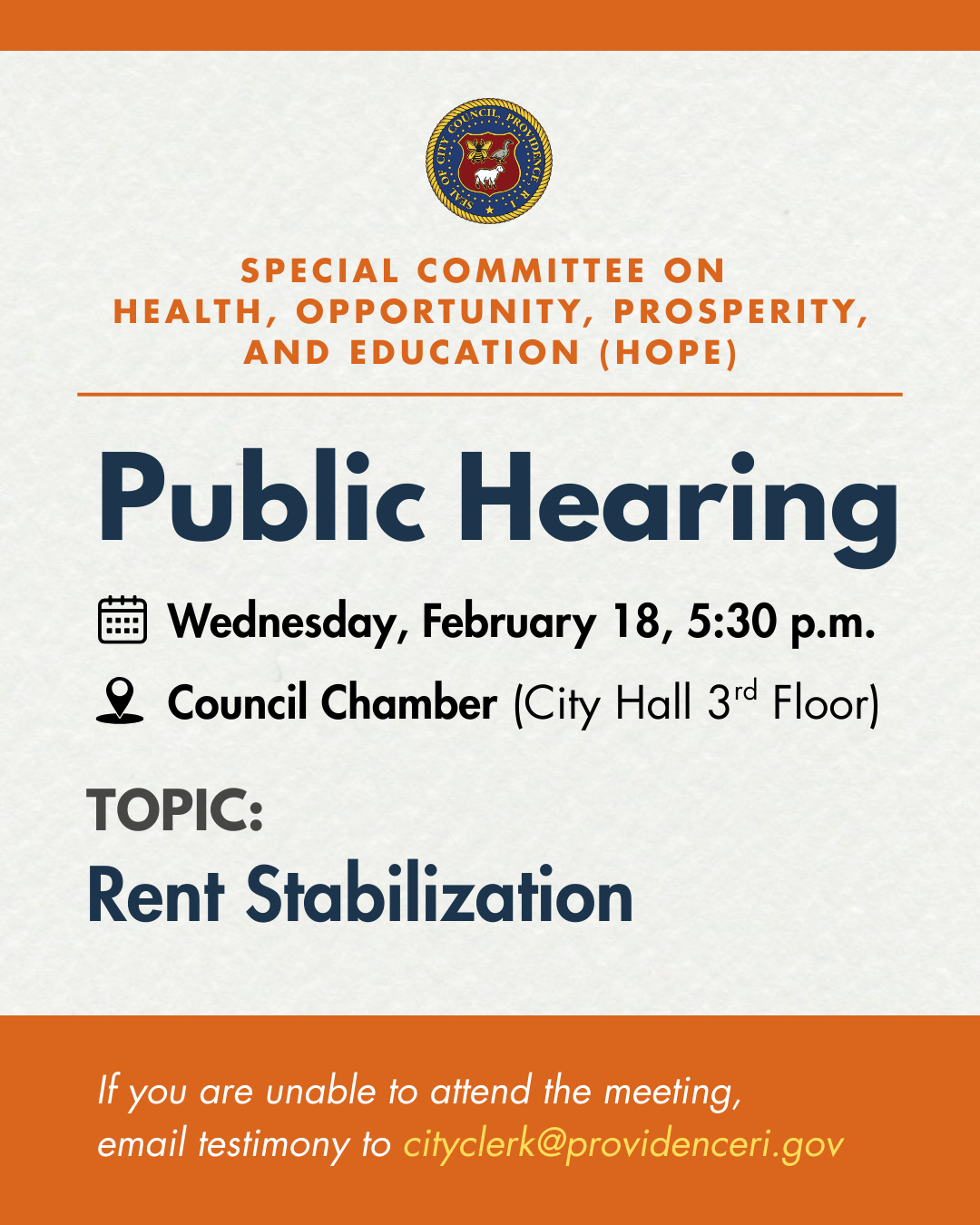
President Pro Tempore Juan M. Pichardo (Ward 9), who chairs the Providence City Council Special Committee on Health, Opportunity, Prosperity, and Education (HOPE), announced that the committee will hold a public hearing on the proposed rent stabilization ordinance. The hearing will be held on Wednesday, February 18, at 5:30 p.m. in the City Council Chamber on the third floor of City Hall. Constituents are encouraged to attend to share their opinions on the ordinance, make suggestions, and hear the thoughts of their neighbors.
“This public hearing marks the beginning of a transparent process where Providence residents can share their experiences, concerns, and ideas about rent stabilization,” said President Pro Tempore Juan M. Pichardo. “Vice Chair Shelley Peterson, our committee members, and I are committed to listening closely to everyone impacted by this proposal—including both renters and homeowners. The strongest policy is always informed by both evidence and the actual experiences of our residents. We look forward to hearing directly from the community as we work toward thoughtful, balanced housing policy for the city we call home.”
The public hearing is one piece of a robust public process that will also include community meetings throughout the city. Under the leadership of Chair Pichardo, the HOPE Committee will carefully consider the public’s input as they continue to vet the ordinance. Following the public hearing, the committee plans to meet on February 23, at 5:30 p.m. to discuss the ordinance and the community feedback received to date. That meeting will not include public comment, and no vote will be taken on the ordinance.